Why Consistent Exterior Lighting Color Matters

Consistent exterior lighting color is defined as the practice of matching color temperature and color rendering across every visible outdoor fixture on your home. Residential lighting professionals almost exclusively specify the 2700K–3000K warm white range for home exteriors, reserving cooler tones above 4000K for security or utility areas. When you mix color temperatures across your roofline, pathways, and landscaping, the result is a disjointed look that undercuts curb appeal and creates real safety problems. For South DFW homeowners in communities like Mansfield, Cedar Hill, and Burleson, getting this right is the difference between a home that looks polished after dark and one that looks like a patchwork of mismatched bulbs.
Why consistent exterior lighting color defines your home’s nighttime look
Uniform color temperature is the single most important factor in exterior lighting design. Mismatched temperatures cause a disjointed look even when every fixture functions correctly. That means two perfectly working lights, one at 2700K and one at 5000K, will make your front elevation look like two different properties stitched together.
Color temperature is measured in Kelvin (K). Lower numbers produce warm, amber-toned light. Higher numbers produce cool, blue-toned light. The 2700K–3000K range mimics incandescent lighting, which most people associate with comfort and hospitality. That association is not accidental. Warm light signals home and rest, while cool light implies alertness and work. Your exterior lighting color scheme sets the emotional tone before a guest even reaches your front door.
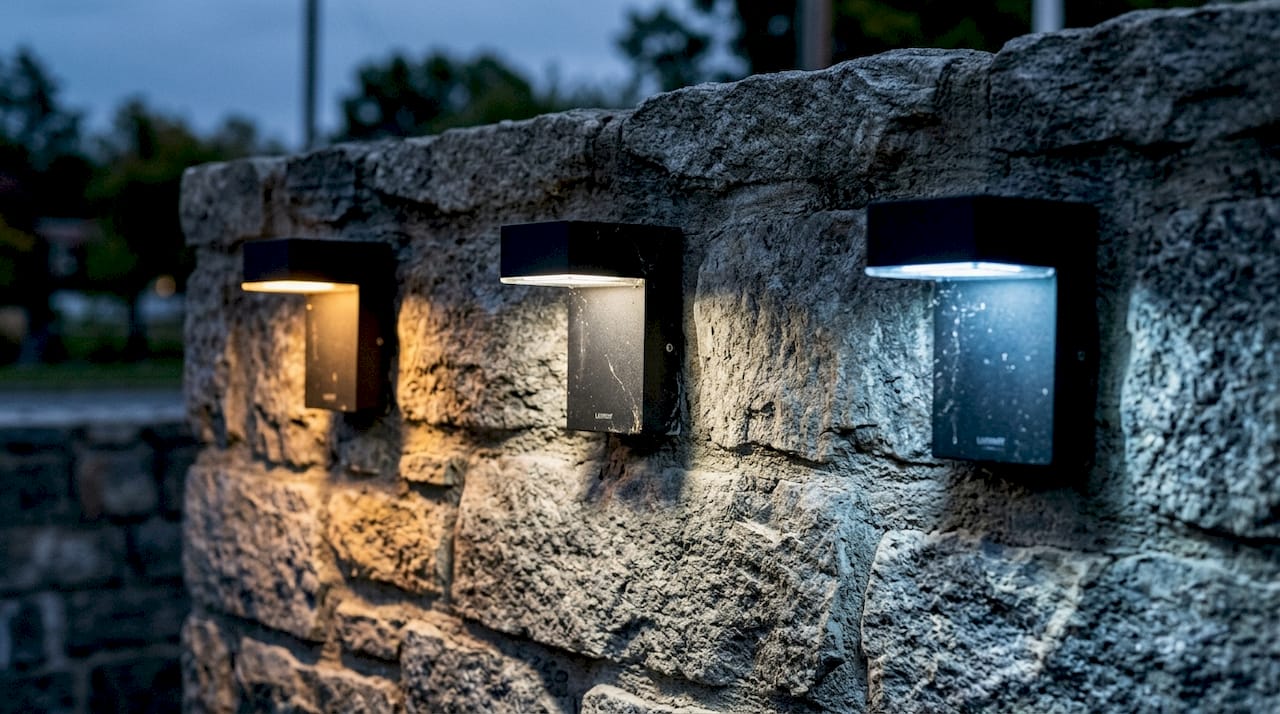
A second technical standard matters just as much: the Color Rendering Index, or CRI. A CRI of 90+ prevents landscaping and architectural finishes from appearing washed out or gray at night. Lower CRI fixtures distort colors, making your red brick look brown and your green shrubs look gray. For South DFW homes with natural stone, rich foliage, and warm brick facades, CRI is not optional. It is the standard.
What color temperature actually does to your home’s exterior
Color temperature changes how every surface on your home looks after dark. Warm white light at 2700K–3000K enhances red brick, rich foliage, and natural stone textures better than cool or daylight tones. That is a direct material response, not a preference.
Here is how different Kelvin ranges perform on common South DFW home materials:
- 2700K: Deep amber warmth. Ideal for brick, wood, and warm stucco. Creates an inviting, residential feel.
- 3000K: Slightly crisper warm white. Works well on lighter stone, painted surfaces, and modern facades. Still firmly in the warm range.
- 4000K: Neutral white. Starts to feel clinical on residential surfaces. Best reserved for garages or utility areas.
- 5000K+: Cool daylight. Makes brick look flat and foliage look gray. Not appropriate for residential front elevations.
The psychological effect is equally real. Warm light creates a welcoming, restful environment. Cool light feels like a parking lot. When your exterior lighting color scheme stays within the 2700K–3000K band, your home reads as a place of comfort from the street.
Pro Tip: Before committing to a fixture, hold a sample light against your home’s exterior wall at night. The difference between 2700K and 3000K is subtle indoors but visible on textured surfaces like brick or stone.
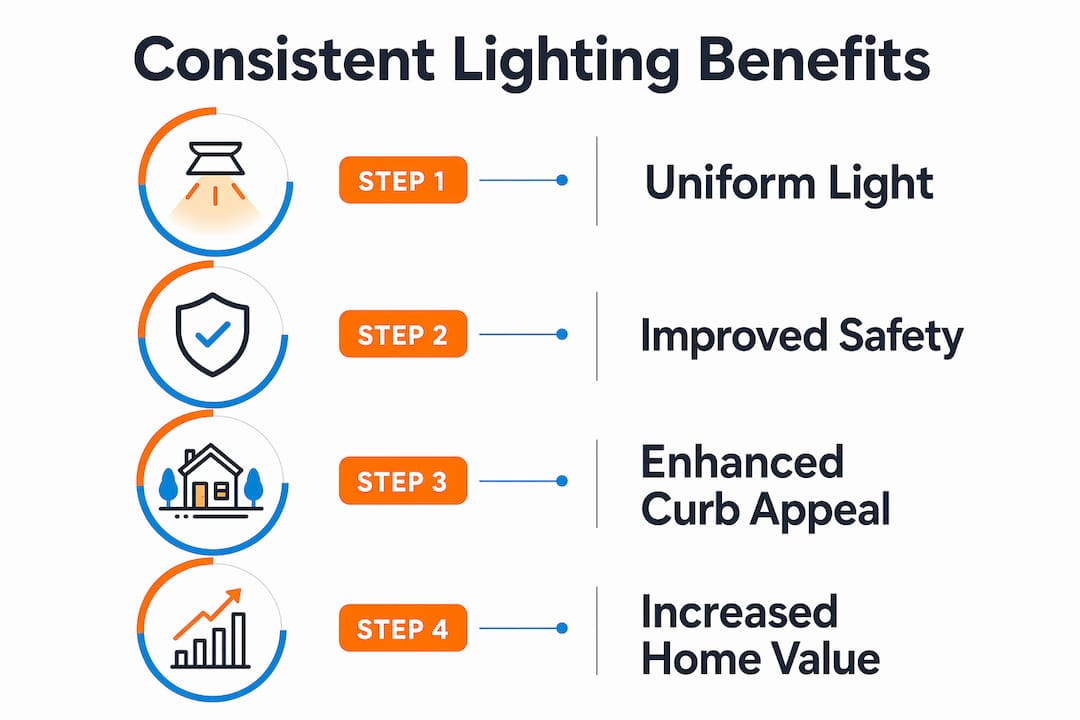
How does uniform lighting color improve safety at night?
Consistent color temperatures minimize harsh contrasts and glare that cause eye strain. Warm white light reduces light spill, glare, and neighborhood disturbances compared to cool white alternatives. That is a safety benefit, not just an aesthetic one.
The safety case for uniform exterior lighting breaks down into four key areas:
- Pathway clarity. Consistent color along walkways removes visual confusion. When one path light is warm and the next is cool, your eyes constantly readjust, which slows recognition of steps, curbs, and obstacles.
- Entrance visibility. Your front door area needs even, shadow-free light. Mismatched fixtures create pools of different-colored light that distort depth perception.
- Perimeter security. Uniform lighting removes dark gaps between fixtures. Gaps and color shifts create blind spots that reduce the effectiveness of your lighting as a deterrent.
- Neighbor and community impact. Consistent, well-controlled lighting prevents light trespass and reduces neighbor complaints. South DFW municipalities increasingly enforce dark-sky ordinances, and warm, directed light is far easier to keep in compliance.
Balanced lighting layers and consistent color temperature work together to support local energy code compliance and prevent light trespass onto neighboring properties. Exterior lighting design is both an aesthetic and a technical compliance issue.
Checking your outdoor LED lighting setup against local dark-sky guidelines is a practical step every South DFW homeowner should take before adding new fixtures.
Common mistakes that break exterior lighting color consistency
Most homeowners assume that buying fixtures with the same Kelvin number guarantees a match. That assumption is wrong. Even fixtures labeled with the same Kelvin rating can differ in color due to manufacturing tolerances. Professionals rely on tight LED binning and unified control systems to guarantee true color uniformity. Matching numbers alone is not enough.
Here are the most common pitfalls to avoid:
- Mixing Kelvin ratings within sight lines. A 2700K wall sconce next to a 5000K flood light creates a jarring visual break. Keep every fixture visible from the street within the same Kelvin band.
- Ignoring dimming effects. Dimming affects perceived color temperature. What looks warm at full brightness may shift hue when dimmed. Always test your lights at the actual brightness level you plan to use.
- Choosing RGB-only LED systems. Cheaper RGB-only LEDs create white light less accurately, resulting in muddy or pinkish hues. Dedicated RGBW systems with a separate white channel produce clean, consistent color rendering.
- Buying from multiple manufacturers without checking binning specs. Two “3000K” fixtures from different brands can look noticeably different side by side. Request the manufacturer’s MacAdam ellipse or SDCM binning data before purchasing.
- Skipping post-installation commissioning. Installing fixtures and walking away is not enough. Test the full system at night, at operating brightness, before signing off.
Pro Tip: Ask your installer to source all fixtures from the same manufacturer batch when possible. Batch consistency eliminates the small color variations that show up between production runs.
How to choose and maintain consistent lighting color for your South DFW home
Choosing the right exterior lighting color scheme starts with two non-negotiable specifications: a color temperature of 2700K–3000K and a CRI of 90 or higher. Those two numbers cover the vast majority of South DFW residential applications. From there, fixture placement and system management determine whether your design holds together over time.
Cohesive lighting design layers different fixture types, such as path lights, wall sconces, and uplights, while keeping all of them at the same color temperature. That layering creates a balanced, dimensional nighttime environment without color clashes.
| Specification | Recommended standard | Why it matters |
|---|---|---|
| Color temperature | 2700K–3000K | Enhances warm materials; creates welcoming atmosphere |
| CRI | 90+ | Renders true colors on brick, stone, and foliage |
| LED technology | RGBW (not RGB-only) | Produces accurate, stable white light |
| Binning tolerance | Tight SDCM (MacAdam ellipse) | Prevents visible color variation between fixtures |
| Dimming test | At operating brightness | Confirms color accuracy under real conditions |
Practical steps for South DFW homeowners:
- Request fixture samples from your installer and view them against your home’s exterior at night before committing.
- Confirm that all fixtures come from the same manufacturer and production batch.
- Schedule a commissioning check after installation to verify color consistency at your intended brightness levels.
- Account for South DFW’s humidity and dense vegetation. Moisture and foliage can shift how light appears on surfaces, especially in spring and fall. Choose fixtures rated IP65 or higher for outdoor exposure.
- Review your popular LED lighting colors for South DFW homes to confirm your Kelvin choice suits local architectural styles.
Consistent lighting also increases home value by creating a polished, professional appearance that stands out in your neighborhood. Exterior lighting is one of the few upgrades visible to every person who drives past your property.
Key Takeaways
Consistent exterior lighting color, achieved through matched color temperature (2700K–3000K) and CRI 90+, is the foundation of safe, attractive, and code-compliant outdoor lighting for South DFW homes.
| Point | Details |
|---|---|
| Color temperature standard | Specify 2700K–3000K for all visible residential exterior fixtures. |
| CRI requirement | Use CRI 90+ to render brick, stone, and foliage in their true colors at night. |
| Avoid RGB-only systems | Choose RGBW LED technology for accurate, stable white light output. |
| Test at operating brightness | Dimming shifts perceived color; always commission your system at real nighttime levels. |
| Match fixtures by batch | Source all fixtures from the same manufacturer batch to eliminate production-run color variation. |
What I’ve learned from watching homeowners get this wrong
The most common mistake I see is homeowners treating exterior lighting as a fixture-by-fixture decision rather than a system decision. They pick a wall sconce they love at the hardware store, then add a path light from a different brand six months later, and a flood light from a third source the following year. By the time the project is “done,” the front of the house looks like a lighting showroom floor, not a home.
The fix is not expensive. It is a mindset shift. Decide on your Kelvin range and CRI standard before you buy a single fixture. Write it down. Treat it like a paint color code. Every fixture you add from that point forward has to match that spec.
What surprises homeowners most is the emotional payoff. When the lighting is consistent, the house feels finished. Neighbors notice. People slow down when they drive past. I’ve had homeowners in Midlothian and Grand Prairie tell me that their consistent exterior lighting design prompted compliments from neighbors who couldn’t quite explain what changed. What changed was that the house finally looked intentional after dark.
Exterior lighting is not decoration. It is a design statement and a safety system. Treat it with the same care you give your interior finishes, and the results will show every single night.
— Adrian
Dfwledpro can match your exterior lighting color perfectly
South DFW homeowners who want a cohesive, professionally designed exterior lighting system have a local partner who knows exactly what it takes. Dfwledpro is the official authorized JellyFish Lighting dealer for the Dallas-Fort Worth metroplex, with installations across Arlington, Mansfield, Cedar Hill, Burleson, and 30+ surrounding communities.
We select fixtures with matched color temperature and CRI 90+ specifications, source from consistent production batches, and commission every system at real nighttime operating conditions. Our team understands South DFW architecture, local HOA requirements, and dark-sky compliance. If you are ready to get your exterior lighting right the first time, our permanent LED installation in Dallas service is the place to start. Contact Dfwledpro for a lighting color assessment and see what your home looks like when every fixture works together.
FAQ
What color temperature is best for home exterior lighting?
The 2700K–3000K warm white range is the professional standard for residential exteriors. This range flatters common South DFW materials like brick, stone, and foliage while creating a welcoming nighttime atmosphere.
Why do my outdoor lights look different even though they’re the same Kelvin rating?
Manufacturing tolerances between different brands and production batches cause visible color variation even at the same stated Kelvin rating. Professionals use tight LED binning specifications to guarantee true color uniformity across all fixtures.
Does dimming change the color of my exterior lights?
Yes. Dimming shifts perceived color temperature, so a warm fixture at full brightness may look different when dimmed. Always test and commission your lighting system at the actual brightness level you plan to use nightly.
What is CRI and why does it matter for outdoor lighting?
CRI, or Color Rendering Index, measures how accurately a light source renders colors compared to natural light. A CRI of 90 or higher is recommended for exterior lighting to keep brick, foliage, and stone looking true to color rather than washed out or gray.
How does consistent exterior lighting affect curb appeal and home value?
Uniform exterior lighting color creates a polished, finished appearance that is visible to every person who passes your property. Consistent lighting is one of the few home upgrades that delivers a visual impact every night, directly supporting curb appeal and perceived home value.