What Is LED Diodes: a DIY Homeowner’s Guide
Most people treat LED bulbs like any other light source. Swap it in, flip the switch, done. But understanding what is LED diodes at a fundamental level changes how you shop, install, and troubleshoot your home lighting. LED diodes are not just efficient bulbs. They are semiconductor devices that generate light through a precise chemical and electrical process. That distinction matters when you are planning a residential lighting upgrade, building a DIY project, or choosing between product options. This guide breaks down how LED diodes work, the types available, and why they are worth understanding before your next install.
Table of Contents
- Key takeaways
- What is LED diodes and how they actually work
- Types of LED diodes and what makes each unique
- Why LED diodes outperform traditional bulbs
- Practical DIY tips for working with LED diodes
- My honest take on LED diodes and DIY lighting
- Ready to upgrade your home with professional LED lighting?
- FAQ
Key takeaways
| Point | Details |
|---|---|
| LED diodes use semiconductor physics | Light is produced by electron-hole recombination, not heat, which is why LEDs last so much longer. |
| Material determines color | Different semiconductor compounds produce specific wavelengths, giving you precise color control. |
| LEDs reach up to 90% efficiency | Far outperforming incandescent bulbs at roughly 10% efficiency, LEDs dramatically cut energy costs. |
| Polarity and current control matter | Incorrect wiring or missing current limiting can permanently destroy an LED diode. |
| Professional installation maximizes results | DIY knowledge helps, but expert installation of permanent LED systems delivers the best long-term performance. |
What is LED diodes and how they actually work
An LED, or Light Emitting Diode, is a semiconductor device. The LED diode definition starts with the word “diode,” meaning a component that allows electrical current to flow in one direction only. What makes an LED different from a standard diode is that its semiconductor materials are specifically chosen to emit light when current passes through.
At the core of every LED is a P-N junction, a boundary where two types of semiconductor material meet. The P-type material has an abundance of “holes” (positive charge carriers), and the N-type material has an abundance of electrons. When you apply a forward voltage, electrons from the N-side cross the junction and recombine with holes on the P-side. That recombination releases energy, and in an LED, that energy comes out as photons, which is visible light. This process is called electroluminescence, and it is the fundamental LED light generation mechanism.
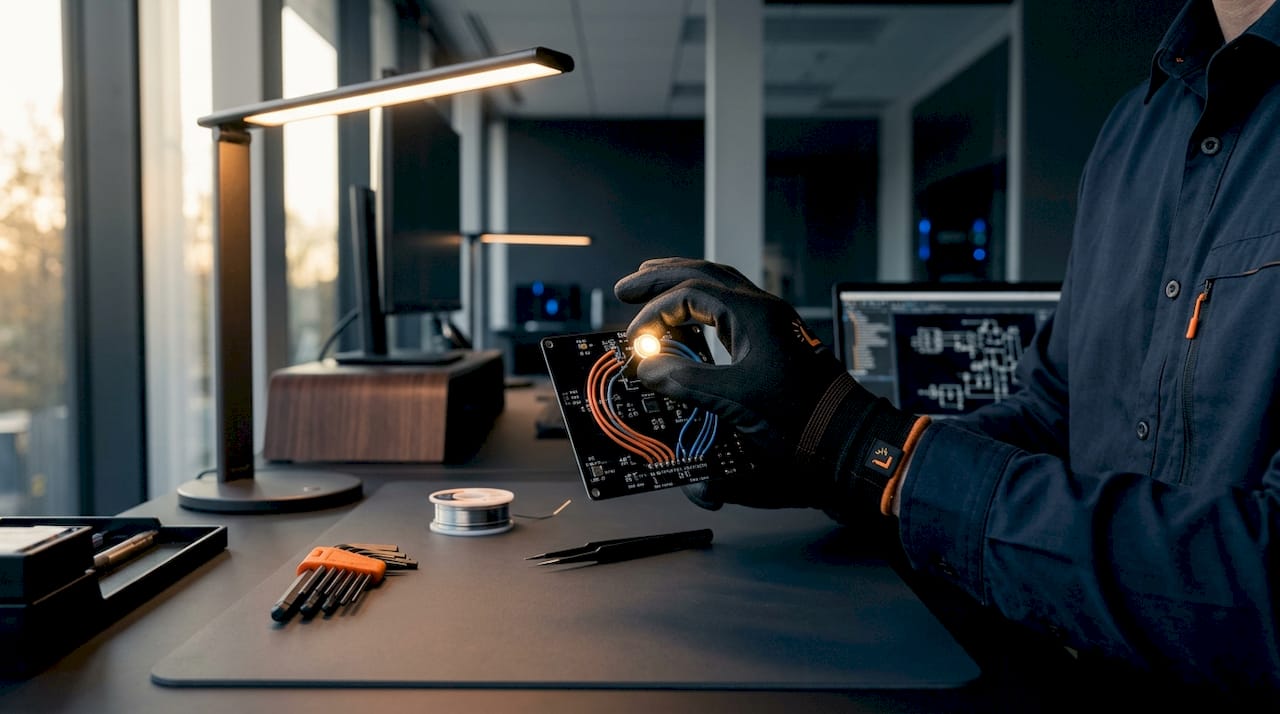
One detail most guides skip: light emission occurs near the P-type region, so manufacturers design LEDs with that junction positioned close to the surface of the chip. This minimizes how much light gets absorbed before it exits the device. The closer to the surface, the brighter the output.
Why forward bias is non-negotiable
LEDs only produce light when connected in the correct direction, which is called forward bias. Reverse the connection and you get no light. Worse, applying enough reverse voltage can permanently damage the semiconductor junction. This is not just a theory. It is one of the most common ways DIYers kill an LED during a first project. Always confirm your positive and negative terminals before powering up.
Pro Tip: Most LED components mark the cathode (negative leg) with a flat edge on the base of the plastic lens and a shorter lead wire. Match the shorter leg to your negative terminal, every time.
The semiconductor materials chosen for an LED also determine the forward voltage needed to activate it. Red LEDs typically need around 1.8 to 2.2 volts. Blue and white LEDs need 3.0 to 3.5 volts. Knowing this matters when you are designing a circuit or replacing components in a DIY lighting project.
Types of LED diodes and what makes each unique
Not all LED diodes are built from the same materials, and that difference is not cosmetic. The semiconductor compound used in an LED sets its color, efficiency, and ideal application. Color output is tied directly to the material’s band gap energy, which controls the wavelength of photons released during recombination.
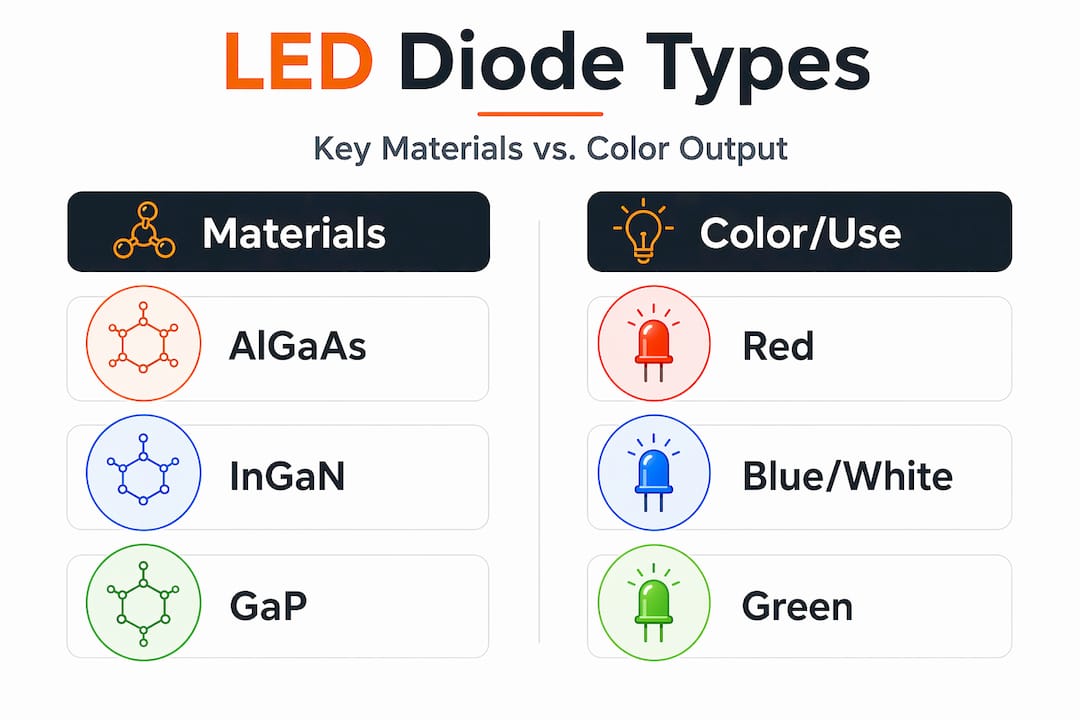
Here is a breakdown of the most common types:
| LED Type | Semiconductor Material | Color Output | Common Use |
|---|---|---|---|
| AlGaAs | Aluminum Gallium Arsenide | Red, Infrared | Indicators, remote controls |
| GaP | Gallium Phosphide | Green, Yellow | Status lights, displays |
| InGaN | Indium Gallium Nitride | Blue, Green, White | General lighting, screens |
| AlGaInP | Aluminum Gallium Indium Phosphide | Orange, Red | Automotive, signage |
| Near-Infrared | Lanthanide-doped nanoparticles | Near-infrared | Emerging biomedical, sensing |
For residential lighting, InGaN is the dominant technology. It produces the blue light that, when combined with a phosphor coating, creates the white light in your LED bulb or strip light. The ability to tune white light from warm (2700K) to daylight (6500K) using phosphor chemistry is one reason LED technology displaced incandescent and fluorescent lighting so completely.
Adding different elements to the base semiconductor compound shifts the color output. Adding aluminum to gallium arsenide produces AlGaAs, which emits red light. Swap to indium-based compounds and you shift toward blue and green. This is why you can find LEDs in virtually any color for your home exterior or accent lighting. If you want to explore popular LED color options for residential use, the range available today is genuinely impressive.
On the cutting edge, researchers have developed near-infrared LEDs using lanthanide-doped nanoparticles with a peak external quantum efficiency above 0.6% at around 5 volts. These are not in your home yet, but they signal where LED technology is heading for specialized applications like medical sensing and night-vision systems.
Why LED diodes outperform traditional bulbs
For a DIY homeowner, the advantages of LED diodes come down to four concrete categories: energy use, lifespan, heat, and operating cost.
-
Energy efficiency. Modern LEDs convert up to 90% of electrical energy into light, compared to roughly 10% for incandescent filaments. The other 90% of an incandescent bulb’s energy output is heat, which is wasted. Switching your home lighting to LEDs can cut your lighting electricity bill by as much as 80%.
-
Lifespan. A quality LED diode is rated for 25,000 to 50,000 hours of operation. A standard incandescent bulb lasts around 1,000 hours. That means one LED can outlast 25 to 50 traditional bulbs. For hard-to-reach fixtures or permanently mounted outdoor systems, this longevity is not just convenient. It is a genuine cost savings. Learn more about LEDs vs. halogen bulbs for a direct comparison.
-
Heat output. Because LEDs convert most energy directly into light, they run cool to the touch under normal conditions. Incandescent bulbs and halogens run hot enough to cause burns or fire hazards in enclosed fixtures. LEDs in enclosed spaces still need some thermal management, but the baseline risk is far lower.
-
Instant-on performance. LEDs reach full brightness in milliseconds. Fluorescent lights, by contrast, often flicker and take time to warm up. For security lighting or motion-activated systems, that instant response is a real functional advantage.
When you factor in reduced replacement frequency, lower energy bills, and the ability to integrate with home lighting automation, the long-term financial case for LED diodes in residential settings is straightforward.
Practical DIY tips for working with LED diodes
Understanding LED diode applications is one thing. Getting them to work correctly in your home project is another. Here are the critical considerations that experienced DIYers know and beginners often overlook.
- Always use a current-limiting resistor or driver. LEDs are highly sensitive to current. Without current limiting, thermal runaway occurs and the LED fails immediately or within minutes. Calculate the resistor value using Ohm’s law before connecting anything.
- Respect polarity. As covered earlier, reversed polarity means no light at best and permanent damage at worst. Double check your wiring against the LED’s datasheet.
- Manage heat at the fixture level. Individual LED diodes run cool, but LED strips and arrays can generate significant heat over a run. Use aluminum channel mounting for LED strips to act as a heat sink. Without it, diodes degrade faster and color shifts over time.
- Match the LED driver to your load. Underpowered drivers cause flickering. Overpowered drivers can shorten diode life. Size your driver to 80% of its maximum rated wattage for the most reliable operation.
- Check IP ratings for outdoor use. Outdoor LED applications require water resistance. IP65 is sufficient for most covered outdoor areas. IP67 or higher is needed for exposed installations or strip lighting near water features.
Pro Tip: When building a DIY LED strip project, buy 10 to 15% more strip than you think you need. Cutting errors, miswiring a section, or underestimating a run length are common. Having spare material on hand prevents a frustrating second order delay.
For outdoor permanent LED systems on your home’s exterior, the complexity of waterproofing, driver sizing, and color control often makes professional installation the smarter choice over a full DIY build. For smaller indoor projects, a solid understanding of the above principles gets you most of the way there.
My honest take on LED diodes and DIY lighting
I have seen hundreds of homeowners swap out bulbs and call it an LED upgrade. That is not wrong, exactly. But it does leave a lot of value on the table.
In my experience, the people who get the most out of LED lighting are the ones who understand at least the basics of how LED diodes work. They make better buying decisions. They choose the right color temperature for each room. They recognize when a cheap LED strip product is going to fade or flicker within a year because the driver is undersized.
What I have learned working with residential LED systems is that the technology gap between a $3 LED strip and a properly engineered system is enormous. The semiconductor materials, the thermal design, the driver quality. They all show up in how the light looks and how long it lasts. Cheap products use lower-grade semiconductor compounds, and you see it in inconsistent color output and early failures.
The other thing people underestimate is the cumulative effect of poor thermal management. One DIY LED strip with no aluminum backing feels fine for a few months. Run it for two summers in a Texas garage and the color shifts noticeably yellow. The diodes are degrading because the heat has nowhere to go.
My take: learn enough about LED diodes to evaluate what you are buying. Read datasheets. Check the forward voltage range. Look at the IP rating and the driver specs. That knowledge pays for itself quickly, whether you are doing it yourself or hiring a pro.
— Adrian
Ready to upgrade your home with professional LED lighting?
At Dfwledpro, we install permanent outdoor LED lighting systems across the Dallas-Fort Worth area, including Lancaster, Dallas, and Midlothian. We are the official authorized JellyFish Lighting dealer in the metroplex, which means every installation uses professional-grade LED diodes, weatherproof hardware, and properly engineered drivers built to handle Texas summers.
If you want the performance of quality LED technology without the trial-and-error of a DIY build, we handle every detail from driver sizing to color-matched mounting hardware. Our permanent LED systems come with a lifetime warranty and full app control, so you get the right light, every time.
Explore our Lancaster LED installation services, or get details for LED installation in Dallas and Midlothian homeowners. Reach out to Dfwledpro today to schedule a free consultation.
FAQ
What is an LED diode, exactly?
An LED diode is a semiconductor device that produces light when electrical current flows through it in the forward direction. The light comes from electron-hole recombination at a P-N junction, a process called electroluminescence.
How do LED diodes produce different colors?
Color is determined by the semiconductor material’s band gap energy, which controls the wavelength of photons released. For example, InGaN produces blue and white light, while AlGaAs produces red light.
Can you connect an LED diode without a resistor?
No. Without a current-limiting resistor or driver, the LED draws too much current, causes thermal runaway, and fails almost instantly. Always size and install proper current control before powering any LED circuit.
How long do LED diodes last compared to regular bulbs?
Quality LED diodes are rated for 25,000 to 50,000 hours, compared to roughly 1,000 hours for a standard incandescent bulb. That translates to decades of use in typical residential applications.
What types of LED diodes are used in home lighting?
Most residential lighting uses InGaN-based LEDs, which produce the blue light converted to white via phosphor coating. Warm white, cool white, and daylight color temperatures are all achieved through variations in that phosphor chemistry.