The Role of LED in Municipal Lighting: A Planner’s Guide

Most municipal planners already know LEDs save energy. That’s not the insight. The real role of LED in municipal lighting is far wider: these systems now function as enabling infrastructure that supports public safety, urban aesthetics, environmental goals, and smart city connectivity all at once. If your department is still evaluating LEDs purely through a utility bill lens, you’re leaving significant planning value on the table. This guide covers the technical fundamentals, design principles, smart integration strategies, and practical pitfalls that every urban planning professional needs to understand before the next procurement cycle.
Table of Contents
- Key takeaways
- The role of LED in municipal lighting fundamentals
- Urban aesthetics, safety, and community acceptance
- Smart city integration and energy management
- Practical considerations for municipal LED projects
- My perspective on LED’s real value in urban spaces
- How Dfwledpro can support your LED lighting goals
- FAQ
Key takeaways
| Point | Details |
|---|---|
| LEDs go beyond cost savings | Municipal LED systems support safety, aesthetics, and smart city connectivity, not just energy reduction. |
| Design quality prevents backlash | Poor light quality and glare cause community rejection; layered, hierarchy-based design prevents this. |
| Smart controls multiply savings | Dynamic LED controls unlock an additional 20 to 50% energy savings beyond baseline LED efficiency. |
| Control interface standards matter | Fixtures with 7-pin NEMA or Zhaga Book 18 ports allow future sensor upgrades without replacing hardware. |
| Pre-procurement simulation is non-negotiable | Optical simulations using tools like AGi32 prevent over-lighting, glare complaints, and failed rollouts. |
The role of LED in municipal lighting fundamentals
LED technology is not new, but its application in large-scale municipal infrastructure has matured considerably over the last decade. Understanding what makes LEDs structurally different from high-pressure sodium or metal halide fixtures helps you make better procurement and deployment decisions.
The core advantages for municipalities break down cleanly:
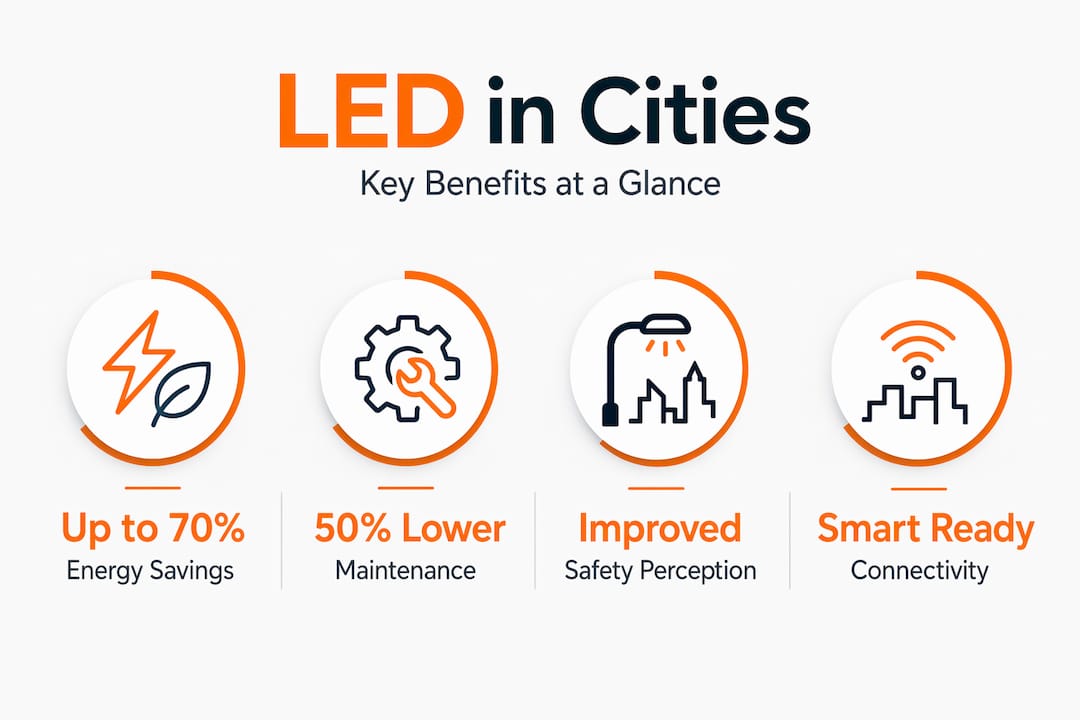
- Energy consumption: Transitioning to LED reduces energy use by up to 70% compared to legacy street lighting. That’s not a marginal gain. For a city with 20,000 fixtures, it’s a budget transformation.
- Maintenance intervals: LED luminaires typically last 50,000 to 100,000 hours. Traditional HPS lamps require replacement every 3 to 5 years. Across a large network, near-zero maintenance labor over five years is a realistic outcome.
- Environmental impact: Lower energy draw directly reduces carbon emissions from grid-sourced electricity. Combined with the absence of mercury (which fluorescent and HPS lamps contain), the environmental case is strong.
- Color rendering: LEDs produce a higher Color Rendering Index (CRI) than HPS, meaning faces, signage, and road markings are more accurately visible under LED light. This has direct public safety implications.
- Adaptive capability: LED is the only technology that integrates smoothly with dimming, scheduling, and sensor-driven controls. Smart lighting systems unlock an additional 20 to 50% energy savings beyond the baseline LED efficiency gain when dynamic controls are deployed.
The LED street lighting benefits compound over time. Energy savings fund capital recovery. Reduced maintenance frees public works staff. Better light quality improves community perception of safety in parks, transit corridors, and commercial zones.
Pro Tip: When building your LED business case for council, separate the energy savings from the maintenance labor savings. Facilities and public works budgets are often siloed, and showing both figures independently tends to win broader departmental support.
Urban aesthetics, safety, and community acceptance
Here is where most municipal LED projects either succeed or fail. Overemphasis on energy savings without regard to light quality often causes public backlash and derails otherwise sound programs. The technology delivers on efficiency. The failure point is almost always design.
Consider what happened in Norfolk, Virginia. The city’s LED conversion program was halted mid-rollout after residents reported unacceptable light intrusion and excessive brightness in residential neighborhoods. The project was planned to replace 30,000 fixtures over five years. Community complaints forced a stop. The technology was fine. The deployment approach was not.
A well-structured lighting hierarchy enhances safety without flattening space or causing visual discomfort. Lighting should serve people’s movement and perception, not simply fill an area with lumens.
Good municipal lighting design follows a layered approach:
- Orientation lighting covers the primary roadway or pathway, providing adequate luminance for vehicle and pedestrian navigation.
- Accent lighting highlights architectural features, public art, green spaces, and landmarks that define a community’s identity.
- Atmospheric lighting creates ambient softness in plazas, parks, and gathering areas to support social activity.
Outdoor lighting quality depends on managing glare and light pollution through deliberate fixture selection and placement. Full cutoff fixtures that direct light downward are non-negotiable in residential corridors. Correlated color temperature (CCT) choice matters too. A 4000K or 5000K source feels clinical and harsh in a neighborhood setting. A 3000K source reads as warmer and less intrusive while still meeting roadway illuminance standards.
Pro Tip: Run community surveys or focus groups before finalizing CCT and lumen output specs. Public perception of “bright” is subjective. A participatory design process creates stakeholders instead of opponents.
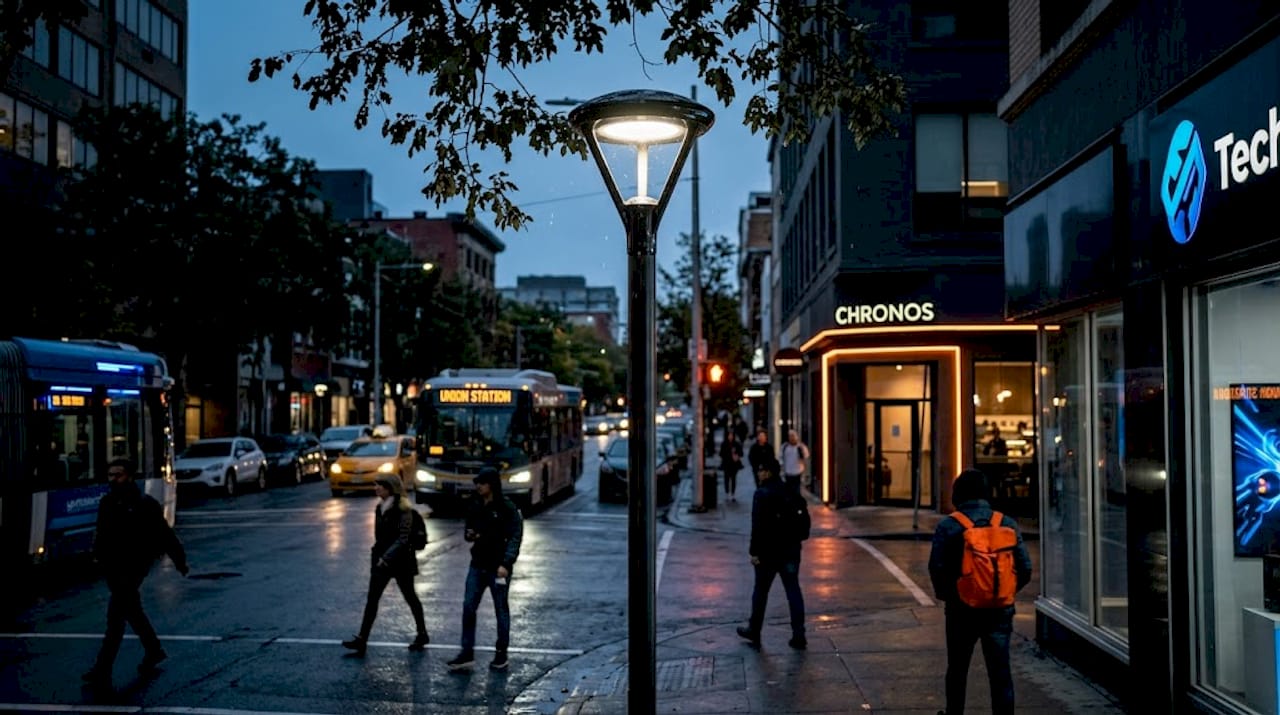
An emerging trend worth tracking: slim, discreet fixtures blended into landscape features are replacing tall cobra-head poles in pedestrian zones. These installations reduce visual clutter during the day and produce atmospheric, lower-level illumination at night. This is particularly effective in parks, heritage districts, and waterfront corridors where the role of LEDs in outdoor design extends beyond safety into place-making.
Smart city integration and energy management
The smart street lighting market is projected to reach $5.4 billion by 2033 with a 6.1% compound annual growth rate, driven by IoT-enabled luminaires and municipal sustainability mandates. The reason for that growth is straightforward: LED is the platform on which smart city lighting infrastructure is built.
Here is how a phased smart integration typically works for a mid-sized municipality:
- Baseline LED conversion. Replace legacy fixtures with LED luminaires that include a standard control interface port (7-pin NEMA or Zhaga Book 18). No sensors yet. Just compatible hardware.
- Network layer deployment. Install wireless communication nodes, either cellular or mesh-based, to connect fixtures to a central management platform.
- Sensor integration. Add occupancy sensors, ambient light sensors, and environmental monitoring nodes. Fixtures automatically dim when streets are empty and brighten when pedestrian or vehicle activity is detected.
- Data-driven optimization. Use real-time usage data to refine dimming schedules, identify outages instantly, and generate maintenance work orders automatically.
The table below shows how these stages compare on cost, complexity, and operational impact:
| Phase | Upfront cost | Operational impact | Reversibility |
|---|---|---|---|
| LED conversion only | Medium | High energy savings | N/A |
| Network layer added | Medium-high | Remote monitoring enabled | High |
| Sensor integration | High | Adaptive dimming, 20-50% added savings | Medium |
| Full data optimization | Low (software) | Predictive maintenance, equity reporting | High |
Standardizing control interfaces such as 7-pin NEMA or Zhaga Book 18 is the single most important technical decision in a long-term LED program. It allows tool-less retrofitting of sensors or communication nodes years after the initial installation. Skipping this step to save $8 per fixture on procurement day means paying full replacement costs when the city is ready for smart controls in year three or four.
AI-driven adaptive urban lighting offers additional efficiency and reduced light pollution but faces real institutional barriers. Procurement routines, regulatory norms, and risk aversion within municipal organizations slow adoption. The cities making the most progress are those that have aligned their lighting upgrades with existing sustainability plans, transportation master plans, and energy management frameworks. LED lighting as enabling urban infrastructure works best when it is not treated as a standalone capital project.
Practical considerations for municipal LED projects
Planning a municipal LED program requires more discipline than simply selecting a fixture and issuing a purchase order. Several common failure points are entirely avoidable with the right preparation.
- Run optical simulations before procurement. AGi32 and similar tools allow your team to visualize light distribution on facades, roadways, and pedestrian areas before a single fixture is installed. This prevents over-lighting, identifies glare problems, and gives you defensible documentation if community concerns arise later.
- Address light intrusion proactively. Residential zones adjacent to arterial roads are the most common complaint sources. Specify house-side shields on fixtures in these locations during the design phase. Retrofitting shields after installation costs two to three times more.
- Require compatible control interfaces in your RFP. Write the 7-pin NEMA or Zhaga Book 18 interface requirement directly into your procurement specifications. Some vendors will push commodity fixtures without these ports. Do not accept substitutions.
- Align with your city’s sustainability and budget cycle. LED projects that are scoped within an existing Climate Action Plan or energy efficiency program access different funding sources, including federal grants and utility rebates, than standalone capital requests. The energy efficiency gains in street lighting that matter to your finance department are the same ones that qualify for ENERGY STAR and utility incentive programs.
- Phase your rollout by priority corridor. High-traffic arterials, school zones, and transit corridors produce the highest return on the first phase of investment. They also generate the most visible community benefit, which builds political support for subsequent phases.
Pro Tip: Build a small “demonstration block” into your first phase, ideally in a visible civic area. A two-block stretch of well-designed LED lighting does more to build council and community confidence than any presentation slide ever will.
Understanding outdoor LED design principles at a layout level is also worth your time before finalizing fixture spacing and mounting heights. Many procurement errors originate in design assumptions that were never verified against actual photometric data.
My perspective on LED’s real value in urban spaces
I’ve worked with enough municipal lighting projects to have a clear opinion: the cities that get the most out of LED upgrades are the ones that never let the conversation stay purely technical. Energy savings matter. They’re real and they’re significant. But I’ve seen programs stall or fail because the planning team treated LED as an infrastructure swap rather than a design opportunity.
What I’ve learned is that community acceptance is not a soft variable. It’s a hard constraint. The Norfolk situation is not an outlier. It’s a warning sign of what happens when efficiency metrics drive design decisions that should be driven by human experience. Residents don’t care about lumens per watt. They care whether the light outside their bedroom window lets them sleep.
My view is that the most durable municipal LED programs build an interdisciplinary team from the start. You need a lighting designer, not just an electrical engineer. You need a community engagement process, not just a public notice. And you need a procurement specification that locks in smart interface compatibility before the first fixture ships.
The future I see coming is dynamic lighting controls aligned to specific urban scenarios: quieter, warmer light after midnight, brighter activation when a crowd gathers in a plaza, coordinated dimming schedules that follow real pedestrian patterns. That’s not speculative. Cities are doing it now. The ones that standardized their control interfaces three years ago are leading. The ones that didn’t are starting over.
— Adrian
How Dfwledpro can support your LED lighting goals
If the principles in this article are shaping how you think about your next LED project, professional installation expertise matters as much as the fixtures themselves.

At Dfwledpro, we are the authorized JellyFish Lighting dealer for the Dallas-Fort Worth metroplex, and we install permanent outdoor LED systems on commercial and municipal properties across more than 35 cities. Our installations are built for durability, smart compatibility, and the kind of lighting quality that holds up to community scrutiny. Whether you are upgrading a commercial corridor, a public gathering space, or a civic property, we bring the design discipline and technical precision that large-scale projects require. Explore our commercial LED solutions for urban and business applications, or see how our permanent LED installations in Dallas deliver the fixture quality and smart-ready design that municipal planners expect. Ready to discuss a project? Contact Dfwledpro for a professional consultation.
FAQ
What is the main role of LED in municipal lighting?
The role of LED in municipal lighting extends beyond energy savings to include improved public safety, smarter urban design, reduced maintenance costs, and a platform for IoT-enabled smart city controls. LEDs function as multifunctional urban infrastructure when deployed with the right design and control strategy.
How much energy do LED street lights save?
Transitioning municipal lighting to LED can reduce energy consumption by up to 70%, with smart dynamic controls adding another 20 to 50% in additional savings on top of the baseline reduction.
Why do some LED street lighting projects face public opposition?
Community backlash typically stems from excessive brightness, incorrect color temperature, or light intrusion into residential areas. Projects that skip optical simulation, community engagement, or proper fixture shielding are the most likely to encounter organized opposition.
What control interface should municipalities require in LED procurement?
Specify either the 7-pin NEMA socket or Zhaga Book 18 interface in your RFP. Both allow tool-less retrofitting of sensors and communication nodes years after initial installation, protecting your long-term smart city investment without requiring full fixture replacement.
How does LED lighting support smart city goals?
LED luminaires serve as the physical layer of smart city lighting networks. When paired with wireless communication nodes and occupancy sensors, they enable real-time monitoring, adaptive dimming, automatic fault detection, and environmental data collection that feeds into broader urban management platforms.