What Is Programmable Lighting for Outdoor Spaces?
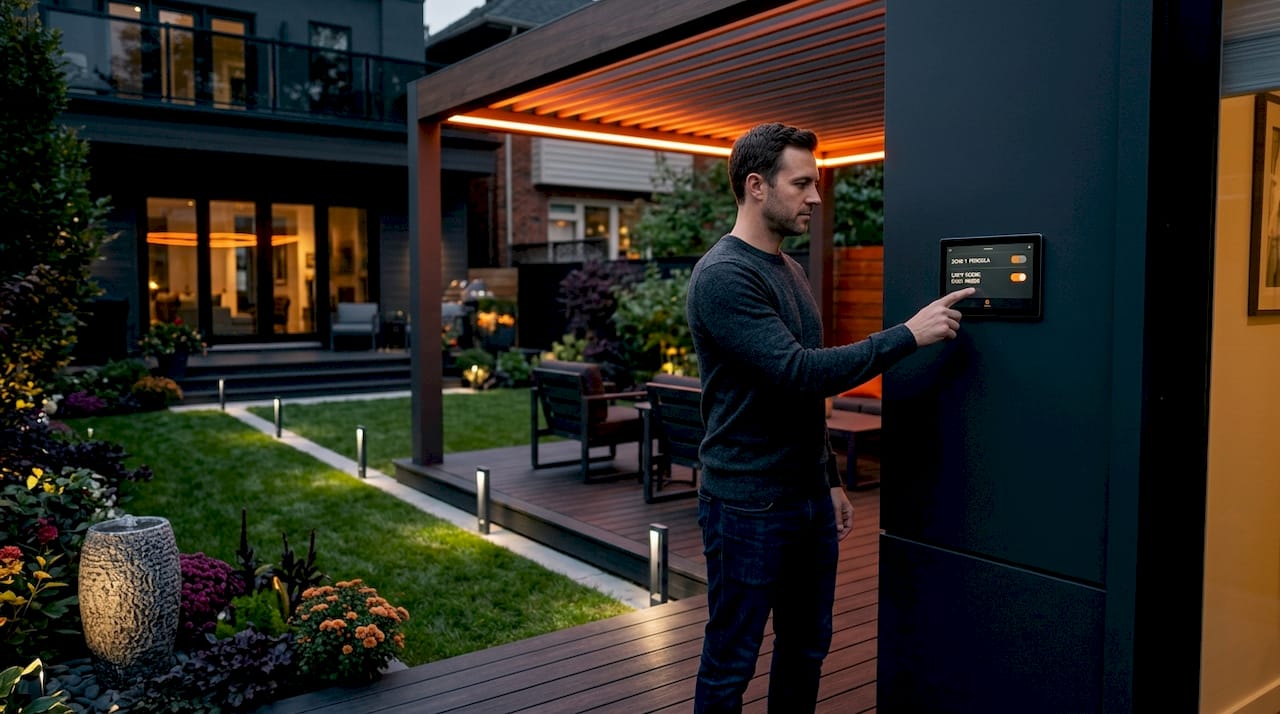
Most homeowners assume programmable lighting means a complicated setup requiring an IT background and a hefty budget. That assumption keeps a lot of people stuck with timer switches and manual controls while missing out on genuine energy savings and curb appeal. What is programmable lighting, really? At its core, it’s any lighting system you can pre-set, schedule, or automate to behave exactly the way you want, without touching a switch. This article breaks down how it works, what makes it worth the investment, and how to use it smartly across your outdoor space.
Table of Contents
- Key takeaways
- What is programmable lighting and how it works
- Benefits of programmable lighting for outdoor spaces
- Integrating programmable lighting into your outdoor smart home
- Types of outdoor programmable lighting solutions
- My honest take on programmable lighting adoption
- Why Dfwledpro brings programmable lighting to life
- FAQ
Key takeaways
| Point | Details |
|---|---|
| Programmable lighting defined | Any lighting system controlled through schedules, apps, sensors, or automation rather than manual switches. |
| Energy savings are real | Dimming LEDs by 50% cuts power use by 40 to 60%, making scheduling and dimming the fastest path to lower bills. |
| Mesh protocols beat Wi-Fi only | Zigbee and Thread networks with dedicated hubs keep your lights running reliably even when your internet goes down. |
| Zone-based control is the key | Grouping lights by location simplifies routines, voice commands, and long-term scalability. |
| Professional installation pays off | Permanent programmable LED systems like JellyFish Lighting offer 50,000 hour lifespans and require zero seasonal effort. |
What is programmable lighting and how it works
Programmable lighting is a system where light fixtures, bulbs, or LED strips are controlled digitally. Instead of a physical switch, you use an app, a voice command, a schedule, or a sensor to tell your lights what to do and when. The intelligence lives in a combination of hardware and software working together.
Most systems rely on one of four wireless communication protocols to send those commands:
- Wi-Fi connects lights directly to your home network, no hub required. Easy to set up, but adds strain to your router as you add more devices.
- Bluetooth works well for small setups in close range. Reliable and private, but limited in distance and scalability.
- Zigbee is a mesh protocol where devices relay signals to each other, extending coverage and reducing single points of failure.
- Thread is the newer mesh standard, built for speed and local control, and the foundation of the Matter smart home protocol.
The direction the industry has moved is toward local control via mesh rather than cloud dependency. Local control means your automations run even when your internet is down, and your response time is nearly instant.
Within these systems, you have three main product types. Programmable bulbs are the simplest option: swap out an existing bulb, connect it to your network, and you have scheduling and dimming capability immediately. Programmable fixtures are permanent installations where the smart technology is built directly into the unit. Then there are addressable LED strips, where each LED is controlled independently through a microcontroller and software, allowing you to create dynamic color patterns, animations, and precise zone effects across your roofline or landscaping.
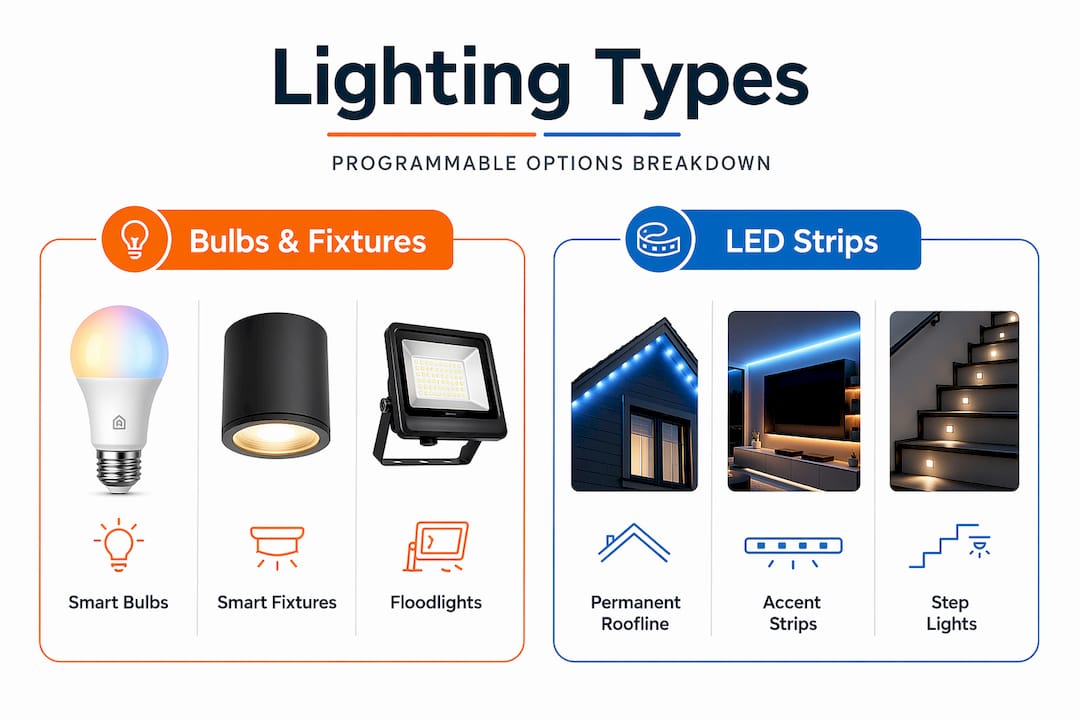
Understanding the differences between these three types helps you match the right product to the right part of your property before you spend a dollar.
Benefits of programmable lighting for outdoor spaces
Energy efficiency you can actually measure
The biggest financial argument for programmable lighting is straightforward. Dimming LEDs by half reduces power consumption by 40 to 60 percent. When you combine dimming with scheduling (turning lights off automatically at 11 p.m. instead of leaving them on all night), the savings compound fast. Pair that with occupancy sensors that only activate lights when someone is actually present, and you have a system that wastes almost nothing.
Here are the primary ways programmable outdoor lighting saves energy:
- Scheduled on/off times prevent lights from running when no one is outside or awake to benefit from them.
- Dimming during low-traffic hours reduces output and consumption without turning lights off completely.
- Occupancy sensors detect motion and activate lights only when needed, particularly useful for driveways and walkways.
- Daylight harvesting uses ambient light sensors to prevent lights from activating when natural light is sufficient.
Stat: High-quality programmable LED systems carry a lifespan of 50,000 hours, which translates to over 22 years at six hours of daily use. You are not replacing bulbs every season. You are installing once and managing digitally.
Pro Tip: Set a “sunset plus 30 minutes” trigger instead of a fixed clock time. This automatically adjusts your lighting schedule as days get shorter or longer throughout the year, without you updating anything manually.
Ambiance, security, and practical comfort
Beyond the utility bill, programmable lighting transforms how your outdoor space feels and functions. You can set warm, low-intensity light along a patio for a weekend gathering and switch to bright white security lighting for a weeknight when you are expecting a late delivery. The system handles both without separate fixtures or manual adjustments.
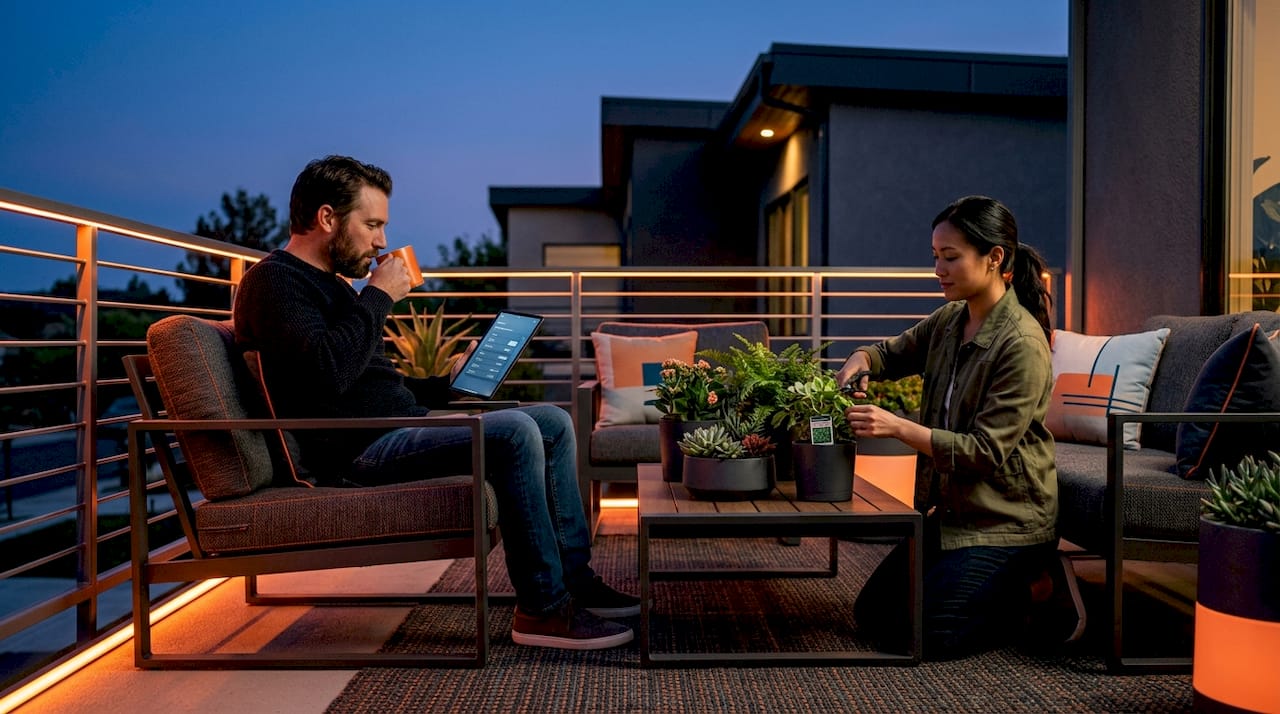
Security is a specific and often underestimated benefit. Automated lighting with varied timing patterns adapts to simulate occupancy, which deters opportunistic intrusions far more effectively than a light left on all night at a fixed brightness. Randomizing schedules when you travel is a feature most smart lighting apps support natively. For property managers overseeing multiple units, this kind of automation runs without tenant involvement, reducing liability and maintenance calls.
The long-term investment angle also factors in. Programmable LED systems built for outdoor use, particularly permanent LED installations designed for weather exposure, carry durability ratings and warranties that make the upfront cost reasonable when spread over two decades of use.
Integrating programmable lighting into your outdoor smart home
Getting programmable lighting to work well within a broader smart home setup is less about adding devices and more about organizing them correctly from the start.
The single most effective practice is grouping lights into zones rather than controlling each fixture independently. Zone-based control simplifies your routines dramatically. Instead of managing 12 individual fixtures, you manage three zones: front yard, back patio, and driveway. One voice command or one routine triggers all lights in that zone simultaneously. This also scales better as you add fixtures over time.
Here is how to build a reliable outdoor programmable lighting setup:
- Use a dedicated hub for Zigbee or Thread devices rather than relying solely on Wi-Fi bulbs. Mesh protocols with dedicated hubs keep local automations running even when your internet connection drops.
- Add motion sensors at key entry points like the garage, front door, and back gate. These trigger zone activation automatically and cut down on manual app use.
- Integrate daylight sensors to prevent your outdoor lights from activating during bright afternoon hours. Sensors paired with lighting controls adjust brightness based on ambient conditions without any manual input.
- Connect to your voice assistant (Alexa, Google Home, or Apple HomeKit) for manual overrides when automation is not what you need in the moment.
- Use local control settings in your app to minimize latency. Cloud-dependent commands can lag by several seconds. Local commands are near-instant.
Pro Tip: Before adding more devices, audit your existing network. If you already have 40 or more Wi-Fi connected devices in your home, adding Wi-Fi bulbs will degrade performance for everything. Switch to a Zigbee or Thread hub setup for your outdoor lighting specifically.
For homeowners building out a smart outdoor lighting system from scratch, starting with a hub-based mesh network and defining your zones first will save you from rebuilding the whole setup six months later.
Types of outdoor programmable lighting solutions
Choosing the right product category matters as much as choosing the right brand. These are the main options and the contexts where each performs best.
| Product Type | Best Use Case | Key Advantage | Consideration |
|---|---|---|---|
| Smart bulbs (screw-in) | Porch lights, lanterns, wall sconces | Plug-and-play, low upfront cost | Limited outdoor durability ratings |
| Programmable LED fixtures | Flood lights, pathway lights, area lighting | Built-in weatherproofing, no bulb changes | Higher initial cost, fixed placement |
| Addressable LED strips | Roofline accents, pergolas, deck perimeters | Full color control, dynamic effects | Requires professional install for reliability |
| Permanent LED systems | Whole-home accent and holiday lighting | Year-round use, single installation | Best with professional setup |
Addressable LED strips are worth a closer look because they behave very differently from the other options. Rather than the entire strip showing one color or brightness, each diode operates independently based on microcontroller instructions. That is what allows effects like color-chasing animations along your roofline or gradient fades across a pergola ceiling. For most homeowners, this level of control is best handled through professionally installed systems rather than DIY strip kits, which require microcontrollers, wiring discipline, and software configuration to perform correctly outdoors.
Decorative and security functions are not mutually exclusive with programmable outdoor lighting. A permanent roofline LED system can run warm white at low intensity for everyday ambiance and switch to bright red and blue for a Fourth of July gathering. That dual-purpose capability eliminates the need for separate seasonal lighting installations entirely.
My honest take on programmable lighting adoption
I have watched a lot of homeowners make the same mistake when they first explore programmable lighting. They focus immediately on the advanced features: color animations, complex scenes, integration with 15 other smart home devices. Then they get frustrated when the setup is unstable or harder to manage than expected, and the lights end up back on a manual switch.
What I have found actually works is starting with the fundamentals. Define your zones. Pick a reliable mesh protocol. Set three simple automations: lights on at sunset, dim to 30 percent at 10 p.m., off at midnight. That alone delivers more practical value than a fully animated system you fiddle with every week.
The real payoff of smart programmable lighting is not the phone control. It is the part where it adapts to your life without you thinking about it. Lights come on when you pull into the driveway. They dim when you sit outside after dinner. They go off when you forget to. That is the version worth building toward.
My recommendation: get the foundation right, run it for 30 days, and then add complexity only where it solves a real problem. The homeowners who end up happiest with their systems are not the ones who installed the most features. They are the ones who installed the right features and let the automation do its job.
— Adrian
Why Dfwledpro brings programmable lighting to life
At Dfwledpro, we are the official authorized JellyFish Lighting dealer for the Dallas-Fort Worth metroplex, and we install permanent programmable LED systems on residential and commercial properties across more than 35 cities. JellyFish Lighting is one of the most capable intelligent lighting solutions on the market, offering full-color addressable control, app-based scheduling, and a permanent installation designed to replace seasonal setups entirely.
If you are a homeowner in Arlington, Fort Worth, Mansfield, or any surrounding community, or if you manage commercial properties across the DFW area, our team handles everything from design to installation. Explore our JellyFish Lighting options or view our permanent LED lighting services to see what a professionally installed programmable system looks like in practice. Contact us to get a tailored quote for your property.
FAQ
What is programmable lighting in simple terms?
Programmable lighting is any lighting system you can control through schedules, apps, sensors, or voice commands instead of a manual switch. It lets you automate when lights turn on, how bright they are, and what color they display.
How does programmable lighting work outdoors?
Outdoor programmable lighting uses wireless protocols (Wi-Fi, Zigbee, or Thread) to connect fixtures to a hub or app. You set schedules, link sensors for motion or daylight, and control everything remotely or through automation routines.
What are the main benefits of programmable lighting?
The top benefits of programmable lighting include energy savings from dimming and scheduling, improved security through automated presence simulation, enhanced outdoor ambiance, and dramatically longer fixture lifespans with quality LED systems.
Is programmable lighting worth it for a single home?
Yes. Even a basic setup with three zones and scheduled on/off times reduces energy waste and eliminates manual control. Permanent systems like JellyFish Lighting provide year-round value from a single professional installation.
What is the difference between smart lighting technology and standard timers?
Standard timers only switch lights on or off at fixed times. Smart lighting technology responds to sensors, adjusts brightness dynamically, integrates with voice assistants, and can be updated remotely from anywhere through an app.