What Is LED Wattage? A Homeowner’s Guide
Most homeowners assume a higher wattage means a brighter bulb. That assumption made sense for decades, but it leads to costly mistakes with LED lighting. What is LED wattage, exactly? It measures how much electricity a bulb consumes, not how much light it produces. Once you understand that distinction, choosing the right LEDs for every room in your home becomes straightforward. This guide covers LED wattage explained from the ground up, including how to read packaging, compare bulbs, calculate energy costs, and avoid the most common mistakes.
Table of Contents
- Key Takeaways
- What LED wattage actually means
- LED wattage vs incandescent: a side-by-side comparison
- Practical implications for your home and energy bill
- How to calculate LED wattage and read packaging
- Common myths and mistakes about LED wattage
- My take on what most homeowners get wrong
- Ready to upgrade your LED lighting?
- FAQ
Key Takeaways
| Point | Details |
|---|---|
| Wattage measures power, not brightness | LED wattage tells you energy consumption; lumens tell you how bright the bulb actually is. |
| LEDs use far less power | LEDs consume 80–85% less electricity than incandescent bulbs for the same light output. |
| Use lumens when comparing bulbs | Match lumens to your room needs, then check wattage to estimate your energy costs. |
| Fixture limits are about power draw | A fixture rated for 60W can safely use a 10W LED, even if it’s labeled as a “60W equivalent.” |
| Calculate before you buy | Multiplying wattage by daily hours of use helps you estimate monthly electricity costs accurately. |
What LED wattage actually means
Wattage is a measurement of electrical power. It tells you how many watts of electricity a device draws from your home’s circuit every hour it runs. For traditional incandescent bulbs, wattage and brightness were closely tied because incandescent technology was inefficient. A 60W incandescent bulb converted most of that electricity into heat, with only a small portion becoming visible light.
LED technology works differently. LEDs produce 75–110 lumens per watt, compared to just 10–15 lumens per watt for incandescent bulbs. That efficiency gap is why a 10W LED can match the brightness of a 60W incandescent bulb. The LED simply converts a much higher percentage of electricity into actual light.
Here is a simple way to think about the core terms:
- Watts (W): The amount of electrical power the bulb draws from your circuit per hour.
- Lumens (lm): The total amount of visible light the bulb produces.
- Volts (V): The electrical pressure pushing current through the bulb (standard US household current is 120V).
- Amps (A): The flow of electrical current. For a 150W LED fixture on a standard 120V circuit, actual current draw is about 1.25–1.4 amps.
Understanding LED wattage means separating these two jobs. Watts tell your electricity meter how much you are spending. Lumens tell your eyes how bright the room will be. You need both numbers to make a smart choice.
Pro Tip: When shopping for LED bulbs, look for the lumens number first. Then check the wattage to estimate what it will cost to run. Never choose a bulb based on wattage alone.
LED wattage vs incandescent: a side-by-side comparison
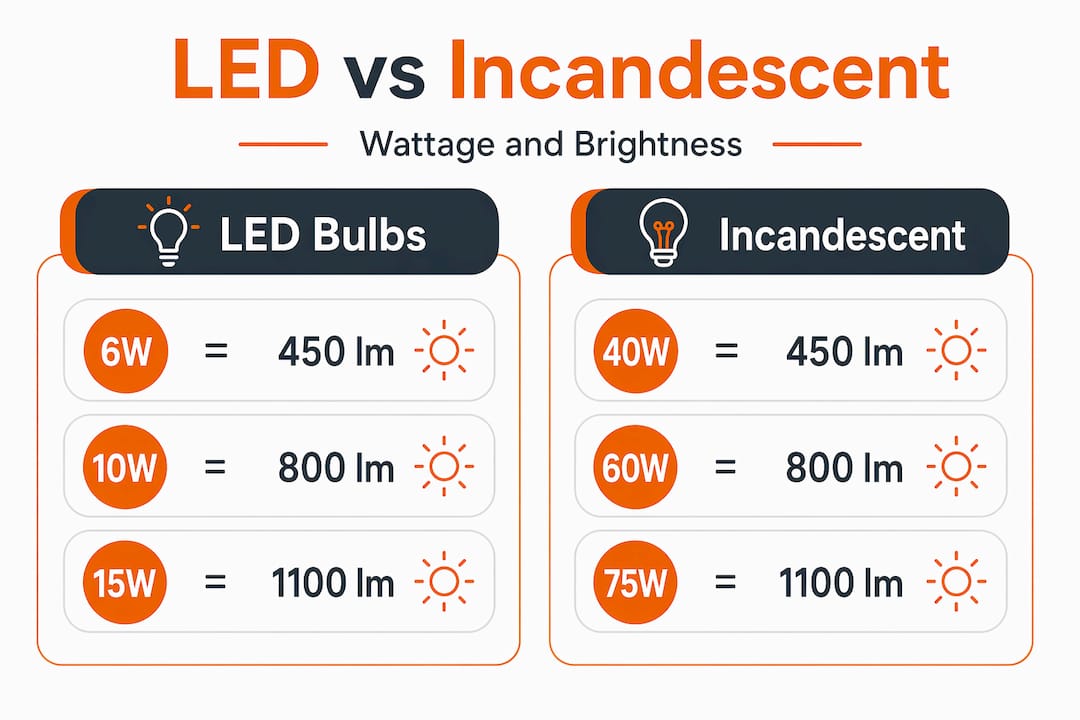
The clearest way to understand LED wattage is to line it up directly against the incandescent bulbs most homeowners already know. This LED wattage comparison shows the practical relationship between watts and lumens across common bulb types.
| Light Output (Lumens) | LED Wattage | Incandescent Wattage | CFL Wattage |
|---|---|---|---|
| 450 lm | 4–6W | 40W | 8–12W |
| 800 lm | 8–10W | 60W | 13–15W |
| 1,100 lm | 12–14W | 75W | 18–25W |
| 1,600 lm | 14–17W | 100W | 23–30W |
| 2,600 lm | 25–28W | 150W | 30–55W |
As the table shows, an 800-lumen LED uses only 8–10 watts to match a 60W incandescent. That is roughly an 85% reduction in energy consumption for identical brightness.
A few important points to keep in mind when using this comparison:
- Equivalent wattage on packaging is not the actual wattage. When a box says “60W equivalent,” that is the incandescent bulb it replaces in brightness. The actual LED wattage will be printed separately, usually 8–10W.
- Lumens measure brightness more accurately than watts for all bulb types, including CFLs.
- CFL bulbs fall in between on efficiency. They use significantly less energy than incandescent bulbs, but LEDs still beat them on both wattage consumption and lifespan.
For replacement projects at home, the process is straightforward. Find the lumens on your old bulb’s packaging or look up the output for a standard incandescent of that wattage. Then select an LED that matches those lumens. The wattage will almost always be dramatically lower.
Practical implications for your home and energy bill
This is where LED wattage explained moves from theory into real savings. Standard household LEDs use 4 to 28 watts, compared to 40–150 watts for incandescent bulbs. Across an entire home, that difference adds up quickly.
Here is a step-by-step approach to estimating your energy savings:
- Count the bulbs. Walk through your home and count how many light fixtures you have and their current wattage.
- Estimate daily use. Most household lights run an average of 3–5 hours per day.
- Calculate watt-hours. Multiply the bulb wattage by daily hours of use. A 60W bulb running 4 hours uses 240 watt-hours, or 0.24 kilowatt-hours (kWh) per day.
- Multiply by your rate. The average US electricity rate is around $0.16 per kWh. One 60W bulb costs roughly $0.038 per day, or about $14 per year.
- Replace with LED. A 10W LED doing the same job costs roughly $0.006 per day, or about $2.40 per year. Multiply by every bulb in your home.
With 30 bulbs replaced from 60W incandescent to 10W LED, the annual savings exceed $340.
Pro Tip: Check the maximum wattage label inside every fixture before installing an LED. Because LED wattage limits relate to power draw, not brightness equivalence, a fixture rated for 60W can safely run a 10W LED that is labeled as “100W equivalent.” You will never exceed the fixture’s limit.

LED wattage guidelines by room also help homeowners make smarter choices. Kitchens and workspaces typically need 3,000–4,000 lumens total. Bedrooms work well with 1,000–2,000 lumens. Bathrooms near mirrors benefit from 1,600–2,000 lumens for accurate color rendering. Hallways and accent lighting can often function well with 200–500 lumens per fixture. Pairing residential lighting controls with your LED upgrades pushes savings even further by reducing total hours of use.
How to calculate LED wattage and read packaging
LED packaging has improved significantly, but it still requires some translation for the average buyer. Here is what to look for on any LED bulb box:
- Actual wattage: The true power draw. This is the number your electric meter will see.
- Equivalent wattage: The incandescent bulb this LED replaces in brightness. This number is usually larger and printed prominently.
- Lumens: The actual brightness output. This is the number you should prioritize.
- Color temperature (Kelvin): Measured in Kelvin (K). Warm white is 2700–3000K. Cool white is 4000–5000K. Daylight is 5000–6500K.
- Beam angle: The spread of light from the bulb. A narrow beam (25–40 degrees) focuses light like a spotlight. A wide beam (100–120 degrees) fills a room.
To calculate LED wattage usage over time, the formula is simple:
Watts x Hours of Use ÷ 1,000 = Kilowatt-hours (kWh)
So a 9W LED running 5 hours daily: 9 x 5 = 45 watt-hours, or 0.045 kWh per day. Over 30 days, that is 1.35 kWh. At $0.16 per kWh, you are spending about $0.22 per month per bulb.
When comparing products side by side, check the lumens per watt figure, sometimes called efficacy. Typical residential LEDs run between 5 and 20 watts, but efficacy varies between brands. A bulb producing 800 lumens at 8W (100 lumens per watt) is more efficient than one producing 800 lumens at 12W (67 lumens per watt). Same brightness, meaningfully different energy cost.
Some newer products go a step further. Multi-wattage selectable LED lamps allow you to switch between brightness levels in the same fixture, which is useful for retrofits where you want flexibility without buying multiple bulb types. This is especially useful in spaces that serve different functions throughout the day.
For deeper guidance on selecting the right product for each space, the LED lighting tips blog at Dfwledpro covers common questions we hear from DFW homeowners.
Common myths and mistakes about LED wattage
Getting LED wattage wrong is easy, and several persistent myths make it worse. Here is what you need to know before buying or installing.
Myth: Higher wattage equals a brighter LED. This is the most common misconception. Two LEDs rated at the same wattage can produce significantly different lumen outputs depending on the quality of the chip and driver. Always compare lumens, not watts, when judging brightness.
Mistake: Matching LED wattage directly to incandescent wattage. If your old fixture used a 60W bulb, you do not need a 60W LED. A 9–10W LED producing 800 lumens is the correct replacement. Installing a 60W LED would produce blinding brightness and almost certainly violate your fixture’s ratings.
Here are the safety and selection points that matter most:
- Never exceed the fixture’s maximum actual wattage with an LED’s real wattage (not its equivalent number).
- Plan circuits conservatively by accounting for power factor and driver inefficiencies, which can push actual current draw above the theoretical minimum.
- Avoid cheap, unbranded LEDs that overstate lumens. Verify claims by checking independent reviews or LED safety guidance before purchasing.
- If you are wiring new circuits or installing permanent LED systems, consult a licensed electrician or certified lighting professional.
Pro Tip: The term “60W equivalent” on the front of a box is a marketing label, not a technical specification. Always flip the box over and find the actual wattage, lumen output, and efficacy before making your decision.
Modern lighting experts consistently emphasize this shift: stop thinking in watts, start thinking in lumens. Watts are for your electricity budget. Lumens are for your lighting plan.
My take on what most homeowners get wrong
I have talked with hundreds of homeowners across the Dallas-Fort Worth area who are mid-project when they realize their bulb choices were based entirely on wattage. They bought “low wattage” LEDs thinking they were saving money, but ended up with dim rooms because nobody explained the lumen difference. Or they bought “equivalent” bulbs and installed them in fixtures that couldn’t technically handle the load, even though the LED wattage was actually safe.
The single shift that clears up almost every LED confusion I have seen is this: treat watts as your electricity budget and lumens as your lighting plan. When I walk homeowners through a lighting upgrade, I start with how bright each space needs to be, expressed in lumens. Then we calculate the wattage to figure out what it will cost to run. The order matters.
I have also seen homeowners overlook beam angle entirely, which is just as important as wattage or lumens for permanent lighting installations. A well-placed 8W LED with a 25-degree beam can illuminate architectural details that a 15W bulb with a 120-degree spread would wash out completely.
My honest recommendation: spend five minutes with the lumen comparison table before you buy anything. If you are planning a larger project, especially for outdoor or permanent LED systems, get a professional assessment. The LED vs. halogen comparison we put together also helps homeowners understand why the efficiency benefits extend well beyond simple bulb swaps.
— Adrian
Ready to upgrade your LED lighting?
At Dfwledpro, we work with homeowners across the DFW metroplex every day on exactly these kinds of lighting decisions. Whether you are replacing indoor bulbs, planning a full exterior upgrade, or considering a permanent outdoor system, understanding LED wattage is just the starting point.

Our team installs professional-grade permanent LED systems across 35+ cities, including Fort Worth, Arlington, and Grand Prairie. If you want expert guidance tailored to your specific home and fixtures, we are here to help. Explore our permanent LED lights in Dallas or check out our JellyFish patio lighting options to see what a properly specified LED system looks like in practice. For homeowners ready to go beyond bulb swaps, our team provides full consultations with no guesswork.
FAQ
What does LED wattage mean for homeowners?
LED wattage measures how much electrical power a bulb draws from your circuit, not how bright it is. Use lumens to judge brightness and watts to estimate energy costs.
How many watts does a typical household LED use?
Most residential LED bulbs use between 5 and 20 watts, depending on the brightness level needed. An 800-lumen LED (equivalent to a 60W incandescent) typically draws 8–10 watts.
Is it safe to use an LED bulb in a fixture rated for higher wattage?
Yes. Fixture wattage ratings refer to the maximum power draw a fixture can handle. A 10W LED bulb is completely safe in a fixture rated for 60W, even if the LED is labeled as a “60W equivalent.”
How do I calculate what my LED lighting costs per month?
Multiply the bulb’s wattage by daily hours of use, then divide by 1,000 to get kilowatt-hours. Multiply that number by your local electricity rate (roughly $0.16 per kWh in most US markets) to find the monthly cost per bulb.
Why do two LED bulbs with the same wattage produce different brightness?
Luminous efficacy varies by manufacturer and LED chip quality. One 10W bulb might produce 800 lumens while another produces only 600 lumens. Always compare the lumen output, not just the wattage, when choosing between products.