Lighting Efficiency Explained for DFW Homeowners
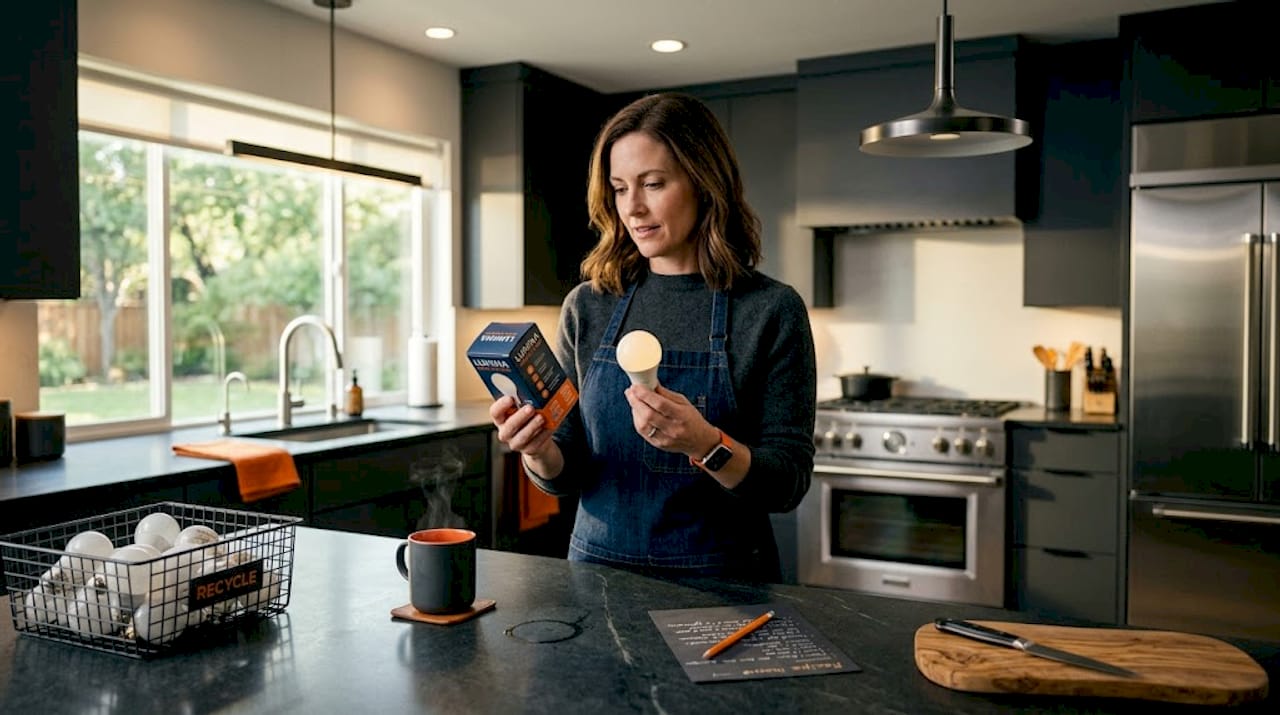
If you’ve ever swapped a bulb and wondered why your electric bill barely moved, lighting efficiency explained clearly might be the missing piece. Most homeowners still shop by watts, which is actually a measure of power consumed, not brightness delivered. In DFW, where summer heat drives up cooling loads and outdoor lighting runs for long hours, that misunderstanding costs real money. This guide walks you through what efficiency actually means, how to measure it, what affects it in the real world, and exactly how to apply it to your home’s outdoor lighting without overcomplicating the process.
Table of Contents
- Key takeaways
- Lighting efficiency explained: lumens, watts, and efficacy
- How efficiency affects your energy bills
- Real-world efficiency: what the spec sheet doesn’t tell you
- Outdoor lighting efficiency for DFW properties
- My take on lighting efficiency myths in DFW homes
- Ready to upgrade your outdoor lighting in DFW?
- FAQ
Key takeaways
| Point | Details |
|---|---|
| Lumens per watt is the real metric | Wattage only tells you consumption. Lumens per watt tells you how much light you’re getting for the energy spent. |
| LEDs cut lighting costs dramatically | Residential LED bulbs use at least 75% less energy than incandescent bulbs and last up to 25 times longer. |
| Controls multiply bulb savings | Smart scheduling, motion sensors, and dimmers can match or exceed the savings from bulb upgrades alone. |
| Outdoor lighting is a big opportunity | Sensors and timers on exterior fixtures reduce unnecessary runtime and protect against over-lighting. |
| Quality matters beyond the spec sheet | LED driver quality and thermal management determine real-world efficiency and how long that performance holds. |
Lighting efficiency explained: lumens, watts, and efficacy
Walk into any home improvement store in Fort Worth or Arlington and you’ll still see light bulbs marketed by wattage. A “60-watt equivalent” label is familiar, but it tells you almost nothing about how efficient the bulb actually is. Understanding lighting efficiency starts with separating two measurements that often get confused.
Watts measure how much electricity a bulb pulls from your wall. Lumens measure how much visible light actually comes out. The relationship between those two numbers is called luminous efficacy, and it’s expressed as lumens per watt (lm/W). Lumens per watt is the best metric for comparing lighting products, not wattage alone.
Here’s why that matters in practice. A 60-watt incandescent produces roughly 800 lumens. An LED producing those same 800 lumens might pull only 8 to 10 watts. Same brightness, a fraction of the energy.
The table below shows how common bulb types compare:
| Bulb type | Typical watts | Typical lumens | Efficacy (lm/W) |
|---|---|---|---|
| Incandescent | 60 W | 800 lm | ~13 lm/W |
| Halogen | 43 W | 800 lm | ~18 lm/W |
| CFL | 13 W | 800 lm | ~61 lm/W |
| Standard LED | 8–10 W | 800 lm | ~80–100 lm/W |
| High-efficacy LED | 4–6 W | 800 lm | ~130–200 lm/W |
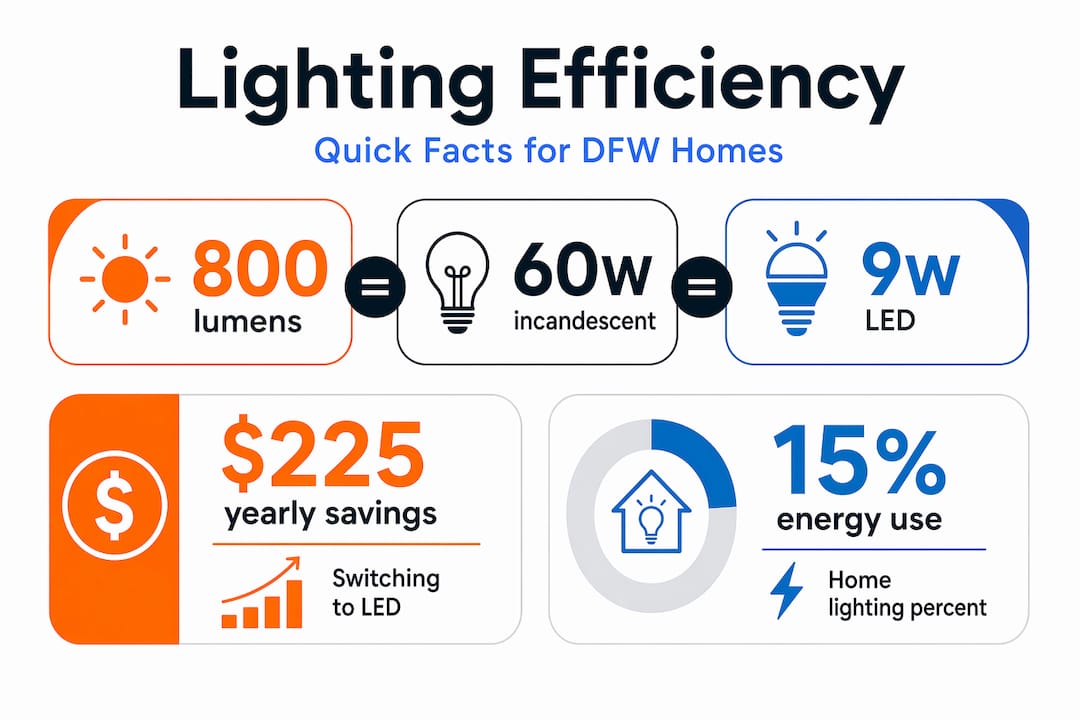
Modern LEDs achieve up to 230 lm/W compared to older LEDs hovering near 100 lm/W. That gap is significant if you replaced your bulbs five or more years ago and haven’t revisited the choice since.
A few key points worth anchoring in your thinking:
- Incandescent bulbs convert most energy to heat, not light. Their low efficacy reflects that waste directly.
- Halogen bulbs improved slightly but are still far behind LEDs on any efficiency measure.
- CFLs were once the efficient standard but carry disposal complications due to mercury content and lose efficacy faster than LEDs.
- LED quality varies significantly by brand and design, which we cover in the next section.
Moving from watt-based brightness comparisons to lumen-based thinking is the single most important shift you can make before buying any new fixture or bulb.
How efficiency affects your energy bills
Lighting accounts for roughly 15% of an average home’s electricity use. For a typical DFW household running central air conditioning heavily from May through September, that percentage may feel small. But 15% of a $200 summer electric bill is still $30 every month, and those outdoor lights you leave on all night add up faster than most people expect.
Switching to ENERGY STAR-rated LED lighting can save approximately $225 annually for the average home. Households still running incandescent or halogen bulbs throughout can see lighting costs drop 50 to 60% after switching.
The data below shows what typical annual savings look like when replacing common bulb types with LEDs:
| Switch | Estimated annual savings per bulb | Whole-home estimate (20 bulbs) |
|---|---|---|
| Incandescent to LED | $6–$10 | $120–$200 |
| Halogen to LED | $4–$7 | $80–$140 |
| CFL to LED | $1–$3 | $20–$60 |
Beyond the dollar amount, lower energy consumption reduces your carbon footprint directly. LEDs produce significantly less CO2 per hour of light compared to incandescent bulbs. For DFW homeowners thinking about long-term property value and sustainability, that matters in a conversation with potential buyers.
Pro Tip: In DFW’s long summers, your outdoor lighting often runs 10 or more hours a night. Installing LEDs with motion sensors on garage floodlights and pathway lighting can cut that runtime in half without sacrificing security or curb appeal.
Real-world efficiency: what the spec sheet doesn’t tell you
Two LED bulbs with identical efficacy ratings on the box can perform very differently after 12 months of use. That’s because LEDs require quality thermal management and drivers to maintain their rated efficiency over time. Cheap LEDs often use inferior drivers that degrade quickly, pulling more power while producing less light.
One key metric to look for is the L70 rating. This tells you how many hours the LED will operate before its light output drops to 70% of its original output. A quality residential LED might carry an L70 rating of 25,000 to 50,000 hours. A bargain-bin option might reach L70 at 10,000 hours, meaning you’ll replace it sooner and lose efficiency well before that point.
Beyond the bulb itself, several environmental and system factors affect real-world performance:
- Fixture design: An LED in a fully enclosed fixture traps heat. Heat shortens LED lifespan and reduces efficacy. Look for fixtures rated for enclosed use if that’s where the bulb goes.
- Dimmers: Not all LEDs are dimmable. Using a non-dimmable LED on a dimmer can cause flickering and reduce the driver’s lifespan.
- Ambient temperature: DFW summers push outdoor temperatures well above 100°F. Outdoor LED fixtures need adequate heat dissipation for the climate here.
- Voltage fluctuations: Older wiring can deliver inconsistent voltage, stressing LED drivers and shortening component life.
Controls are where most homeowners leave savings on the table. Smart lighting controls like motion sensors, scheduling, and dimming can match or exceed the energy savings gained from bulb replacements alone. That’s not a minor point. It means layering controls onto your lighting system is just as important as the bulb you choose.
Residential lighting controls like occupancy sensors, timers, and dimmers work together to reduce runtime precisely where you need it. A motion sensor on a backyard floodlight that would otherwise run from dusk to dawn eliminates hours of unnecessary consumption every single night.
Pro Tip: Smart switches are more cost-effective than smart bulbs for whole-home installations. They control multiple fixtures per device, work with any compatible LED, and avoid locking you into a single brand’s ecosystem. Monitor your usage for 30 to 90 days after installation to verify actual savings and fine-tune schedules.
Outdoor lighting efficiency for DFW properties
Outdoor lighting is where lighting efficiency tips have the most visible impact for homeowners and property managers in DFW. You’re lighting larger areas, often for more hours per night, with fixtures exposed to heat, humidity, and weather. Getting this right pays off in both lower bills and better-looking properties.
Outdoor LEDs are durable and energy-efficient, and when combined with sensors and timers, they deliver significant savings on exterior lighting specifically. Here’s what to prioritize when planning or upgrading:
- Choose weather-rated fixtures. Look for IP65 or higher ratings for fixtures exposed to rain and humidity. DFW sees intense summer storms and significant temperature swings between seasons.
- Use motion-activated floodlights. Garage, driveway, and backyard floodlights don’t need to run all night. Motion activation keeps them ready when needed without constant draw.
- Layer brightness zones. Pathway lighting at 100 to 200 lumens, accent uplighting at 200 to 400 lumens, and security floodlights at 700 to 1300 lumens serve different purposes. Matching brightness to task avoids over-lighting that wastes energy and money.
- Set timers to local sunset and sunrise. DFW daylight hours shift considerably from December to June. A static timer set in winter runs lights longer than needed by April. Astronomy-based timers or smart controls that follow actual sunset times eliminate that drift.
- Consider permanent LED systems. Permanent architectural lighting installed by professionals uses color-matched fixtures and optimized placement from the start, reducing the guesswork that leads to over-lit or poorly distributed outdoor setups.
For DFW property managers overseeing multiple units or commercial lots, smart outdoor LED controls that run on a centralized schedule offer meaningful savings per property and reduce the maintenance calls that come from bulbs failing in hard-to-reach fixtures.
My take on lighting efficiency myths in DFW homes
I’ve seen the same pattern repeat itself across hundreds of DFW homes. Homeowners swap their indoor bulbs, see a small drop in their bill, assume the job is done, and never revisit their outdoor setup. The outdoor fixtures are almost always the bigger opportunity.
The watt habit is deeply ingrained. I regularly talk to homeowners who pick a bulb by reading the wattage as if it’s a brightness number. It’s not. It never was. The industry just trained us to think that way over decades of incandescent dominance, and that thinking costs you money today.
What I’ve also seen consistently is that cheap LEDs create a negative experience that puts people off the technology entirely. A $3 LED from an unknown brand that flickers after six months and dims noticeably within a year doesn’t represent what quality LEDs deliver. Product quality and thermal design separate a 25,000-hour performer from a 6,000-hour disappointment.
The controls piece is the most underused lever available. I’ve watched homeowners spend hours researching the most efficient bulb available, then install it in a fixture that runs 12 hours a night on a fixed timer. Add a motion sensor. Set a smarter schedule. The controls work harder for your savings than the bulb difference ever will.
My practical suggestion: phase your upgrades. Start with outdoor high-runtime fixtures and controls. Then address indoor rooms by usage frequency. Avoid proprietary cloud-locked smart systems that leave you dependent on a company’s subscription or server to operate your lights. Open-platform smart switches give you long-term flexibility without that risk.
— Adrian
Ready to upgrade your outdoor lighting in DFW?
At Dfwledpro, we specialize in permanent outdoor LED lighting installations across the Dallas-Fort Worth area, including Fort Worth, Lancaster, Midlothian, Dallas, and more than 35 surrounding cities. We are the official authorized JellyFish Lighting dealer for the DFW metroplex, which means every installation is backed by professional-grade product and a team that understands local climate demands.
If you want to put what you’ve learned about lighting efficiency into practice, we can help you design an outdoor system with proper fixture ratings, smart controls, and optimized brightness zones tailored to your property. Whether you manage a residential home or a commercial property, our team delivers installations that reduce runtime costs and sharpen curb appeal at the same time. Explore our LED installation in Dallas and Fort Worth LED lighting service pages, or check out options for Lancaster and Midlothian. Contact us for a no-pressure consultation and installation estimate.
FAQ
What is lighting efficiency?
Lighting efficiency refers to how much visible light a fixture produces for each watt of electricity it consumes, measured in lumens per watt. The higher the lumens per watt rating, the more efficient the light source.
Why does lumens per watt matter more than wattage?
Wattage tells you only how much power a bulb consumes, not how bright it is. Two bulbs producing 800 lumens can use very different amounts of electricity, and lumens per watt shows you exactly which one delivers more light for less cost.
How much can I save by switching to LED lighting?
Switching to ENERGY STAR LED bulbs can save the average homeowner around $225 annually, with lighting cost reductions of 50 to 60% compared to incandescent or halogen bulbs.
Do smart lighting controls really make a difference?
Smart controls like motion sensors, scheduling, and dimming can match or exceed the energy savings gained from upgrading bulbs alone, making them one of the highest-impact investments in a lighting efficiency upgrade.
What should I look for in outdoor LEDs for DFW homes?
Look for fixtures with an IP65 or higher weather rating, dimmable LEDs with high L70 ratings, and controls like motion sensors or astronomy-based timers that adapt to DFW’s shifting seasonal daylight hours.