Lighting zone control: Boost home beauty and save energy
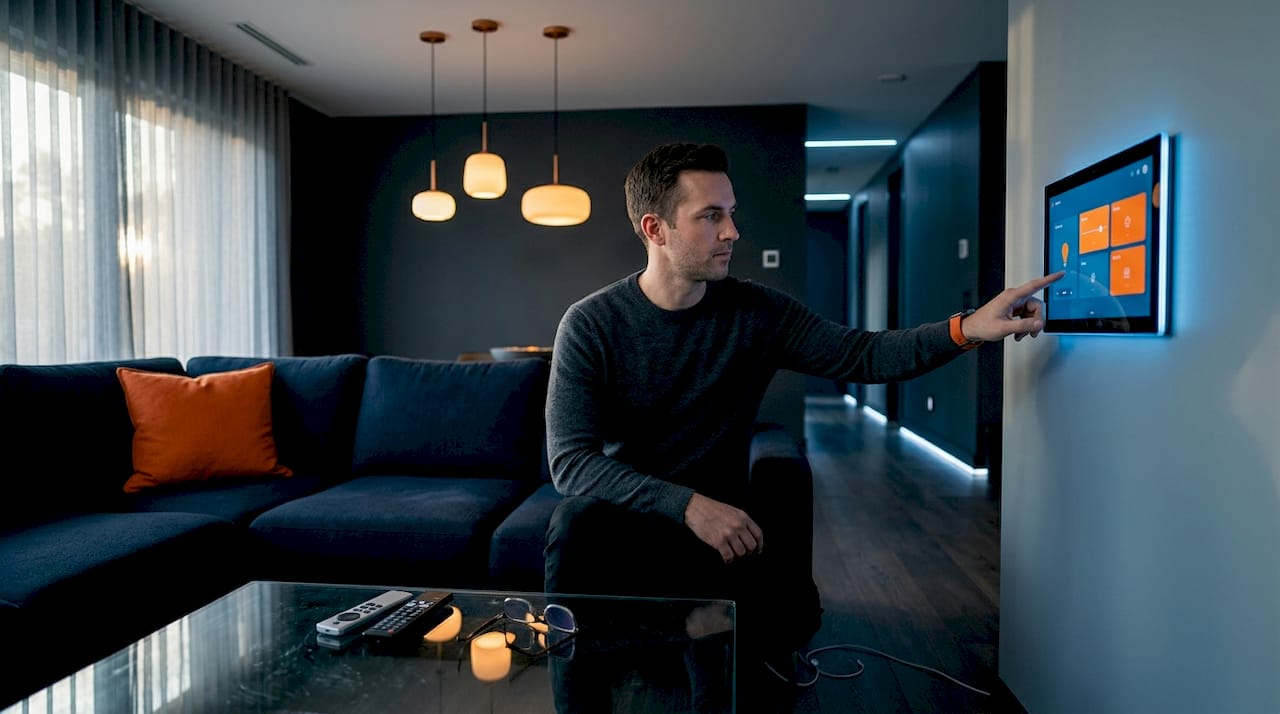
Most homeowners flip one switch and expect every outdoor light to respond the same way, at the same time, for the same purpose. That single-zone approach is limiting your home’s potential without you even realizing it. Lighting zone control changes the game entirely by letting you operate distinct areas of your property independently, matching each light to a specific function, schedule, or mood. For South DFW homeowners who want better curb appeal, tighter security, and lower electric bills, understanding this technology is one of the most practical steps you can take.
Table of Contents
- What is lighting zone control?
- How lighting zone control works: Methods and technology
- Key benefits: Aesthetics, security, and energy efficiency
- Navigating restrictions: HOA, DarkSky, and local codes in DFW
- The reality: What most installers won’t tell you about zone control
- Upgrade your DFW home with expert-installed LED zone control
- Frequently asked questions
Key Takeaways
| Point | Details |
|---|---|
| Tailored lighting control | Lighting zone control lets you customize each area of your property for security, beauty, and fun. |
| Smart tech saves energy | Using timers, sensors, and LEDs can cut your outdoor lighting energy use and bills significantly. |
| Be HOA and wildlife friendly | Follow local and DarkSky guidelines for comfortable, compliant, and eco-friendly lighting design. |
| Flexibility for future needs | A good zone system grows with you, supporting changes and upgrades easily over time. |
What is lighting zone control?
At its core, lighting zone control means dividing your outdoor lighting into separate groups, called zones, and operating each group independently. Instead of every fixture around your home turning on or off together, you decide which areas work on their own schedule or setting.
Think about what that looks like in practice. Your driveway lights come on at dusk for safety. Your backyard string and accent lights run only when you are entertaining. Your front entry lights stay on until midnight, while your landscape uplights shut off at 10 p.m. to save energy. Each area has its own purpose, and zone control honors that purpose instead of forcing everything to behave the same way.
Most outdoor lighting systems organize zones into three functional types:
- Task lighting zones: These cover safety-critical areas like walkways, steps, driveways, and entry points. They prioritize visibility and security over decoration.
- Ambient lighting zones: These provide general brightness across a yard or patio, setting the overall mood for an outdoor space without drawing attention to any single feature.
- Accent lighting zones: These highlight specific architectural details, trees, garden beds, or facades for curb appeal and visual interest.
Modern systems go further by supporting smart outdoor lighting controls that include timers, motion sensors, smartphone apps, and even voice commands. According to the Department of Energy, lighting control systems can group lights by function and support timers, motion sensors, and app or voice scenes, giving you multiple ways to customize your setup without rewiring anything.
“Zone control is not just about convenience. It is about giving every light a defined purpose so nothing wastes energy and nothing goes unnoticed when it matters most.”
You can also program “scenes,” which are preset configurations for different situations. A gathering scene might turn every zone to full brightness. A security scene might activate only your driveway and entry task lights after midnight. A quiet night scene might dim ambient zones while keeping accent lights on low. The flexibility is the point.
How lighting zone control works: Methods and technology
Now that you know what zone control means, let us look at how you can make it work with today’s technology.
There are four primary control methods used in residential outdoor lighting systems. Each has its strengths, and the best results usually come from combining more than one.
- Manual switches: The simplest option. You assign different switches to different zones. Low cost, but requires you to be present and remember to toggle each zone.
- Programmable timers: You set a schedule for each zone. Lights follow a clock-based routine without any daily input from you. Great for consistent results.
- Sensor-based automation: Motion sensors and photocells (light-detecting sensors that disable outdoor lights during daylight hours) add intelligence to your system. The Department of Energy identifies motion sensors, photocells, and timers as key components of effective residential lighting controls.
- Smart device and app control: You manage zones from a smartphone or integrate with voice assistants like Amazon Alexa or Google Home. Systems like this support home lighting automation that lets you schedule, dim, change colors, and group zones without leaving your couch.
Here is a quick comparison of control methods by effort and capability:
| Control method | Setup effort | Flexibility | Best use case |
|---|---|---|---|
| Manual switches | Very low | Low | Simple zone separation |
| Programmable timers | Low | Moderate | Consistent daily schedules |
| Motion and photocell sensors | Moderate | High | Security and energy savings |
| Smart app or voice control | Higher | Very high | Full zone customization |
For integrating smart controls with your existing home setup, most modern systems use wireless protocols that avoid complex rewiring. And if you are using a JellyFish Lighting system, lighting app management puts zone scheduling, color selection, and scene programming right in your palm.
Pro Tip: Do not rely on just one control method. Pair timers with motion sensors so your security zones activate on schedule but also respond immediately if someone enters your driveway unexpectedly. That layered approach costs very little extra but adds significant value.
Key benefits: Aesthetics, security, and energy efficiency
Understanding the “how” is one thing. Let us explore why lighting zone control makes a real difference for your property.
Curb appeal and aesthetics
Accent lighting zones are the most visible payoff. By highlighting specific trees, garden beds, or architectural lines on your home’s facade, you create a polished nighttime appearance that standard all-on lighting simply cannot match. You control exactly which features get attention and at what brightness. The result is a layered visual depth that makes your home stand out on the street.
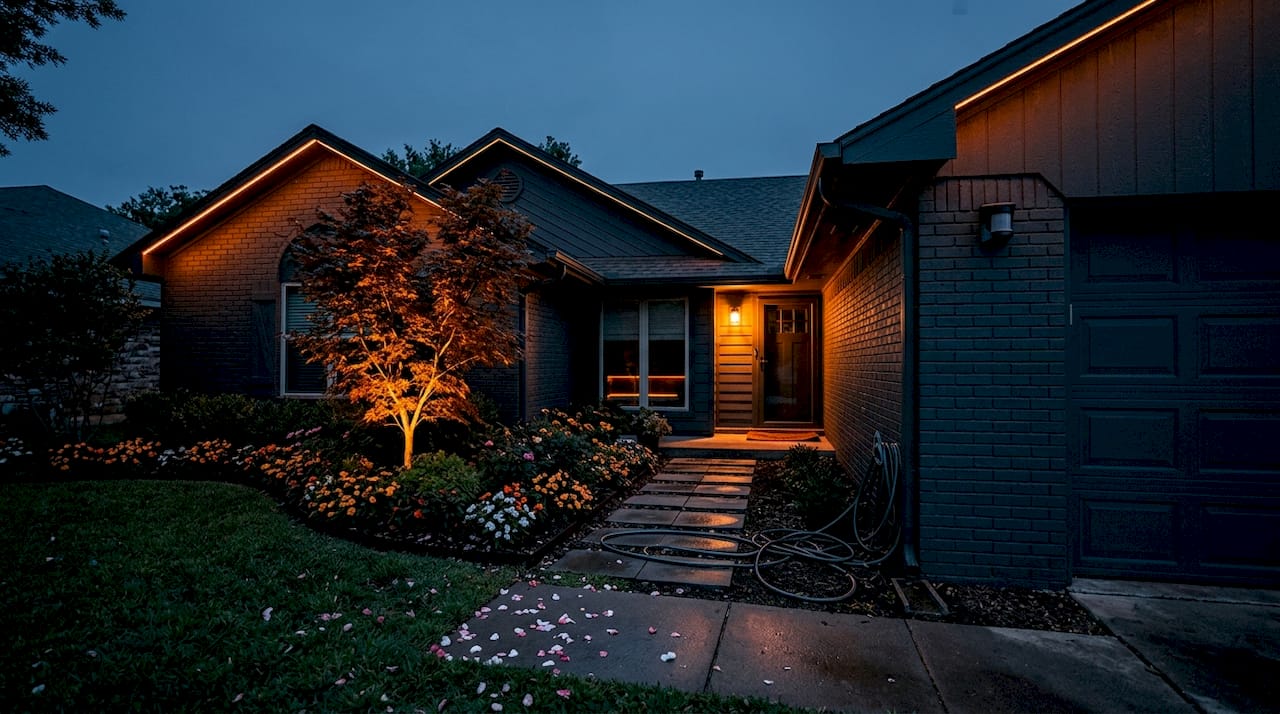
Zoned lighting also prevents the “floodlit” look that comes from turning on every fixture at once. When each zone serves a specific purpose, the overall effect is intentional and refined rather than overwhelming.
Security and safety
Adaptive security lighting is smarter than leaving every light on all night. Motion-triggered task zones on your driveway or walkways respond only when needed, which actually draws more attention to movement than a constant glow that people become desensitized to. You conserve energy and get a more effective deterrent.
Here is a breakdown of common zone benefits by property area:
- Front entry: Timed task lighting for visibility from dusk to midnight, then dimmed or off to save power
- Driveway: Motion-triggered security lights that activate on arrival and shut off after a set delay
- Backyard: Ambient and accent zones on a separate schedule for entertaining, independent of front-of-house settings
- Landscaping: Accent zones on timers that highlight trees or garden beds during evening hours only
- Side yards: Low-level task lighting for pathway safety, separate from decorative zones
Energy efficiency and ROI
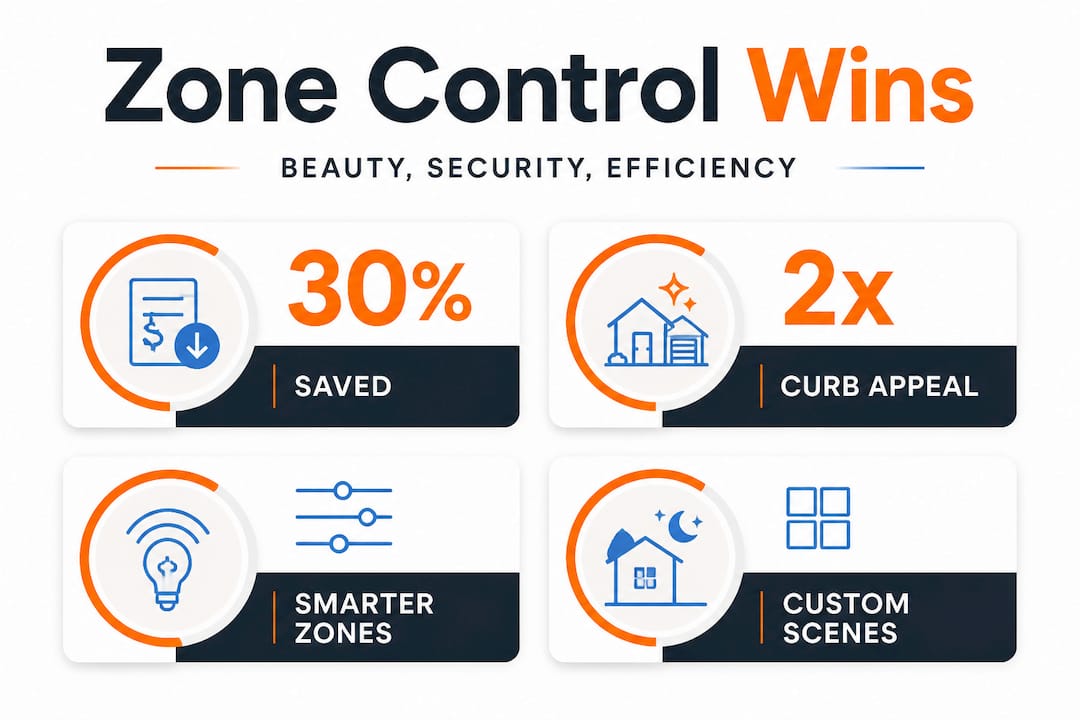
The Department of Energy confirms that LEDs and sensors in zones deliver the best return on investment for residential lighting. Here is why: a standard all-at-once system runs everything at the same wattage for the same duration. A zoned LED system runs only what is needed, at the right brightness, for the right amount of time.
You can explore how LED lights and curb appeal combine to lower monthly costs while elevating your property’s appearance. And with remote outdoor lighting control, you can turn off zones you forgot to schedule without driving home.
| Lighting approach | Energy use | Flexibility | Appearance |
|---|---|---|---|
| All-on single-zone | High | None | Flat, uniform |
| Timers only | Moderate | Limited | Predictable |
| Zoned LED with smart controls | Low | Very high | Layered, polished |
Pro Tip: When calculating energy savings, count not just the wattage of your LEDs but also how many fewer hours each zone runs compared to a single-switch system. The difference across a full year is significant for most DFW homes.
Navigating restrictions: HOA, DarkSky, and local codes in DFW
Once you see the benefits, the next step is making sure your project fits local rules and best practices.
South DFW homeowners live under a patchwork of homeowners association rules, neighborhood covenants, and voluntary guidelines that affect outdoor lighting choices. The good news is that zone control technology itself is rarely restricted. What HOAs typically regulate are fixture appearance, brightness levels, and color temperature.
Common HOA restrictions in the DFW area include:
- Fixture style and finish: Some HOAs require fixtures to match existing architectural styles or approved color palettes.
- Color temperature limits: Many associations require warm white light (typically 2700K to 3000K) to avoid harsh blue-white tones that affect neighbor comfort.
- Brightness caps: Some neighborhoods restrict lumens per fixture to prevent light spillover onto adjacent properties.
- Fixture placement: HOAs may specify where fixtures can be mounted and whether ground-level or overhead placement is acceptable.
The DarkSky movement, represented locally by DarkSky Texas, adds another layer of guidance. Their principles encourage warm-toned LEDs, shielded fixtures that direct light downward, and anti-overlighting to protect neighborhood comfort and local wildlife. Residential lighting in DFW is shaped more by these HOA and DarkSky principles than by commercial energy codes, which gives you flexibility but also puts the responsibility on you to do your homework.
“Choosing the right color temperature and shielding your fixtures properly is not just good citizenship. It keeps your installation looking clean and avoids friction with neighbors or your HOA board.”
Before planning your zone layout, check your HOA’s CC&Rs (covenants, conditions, and restrictions) for any outdoor lighting provisions. If you are unsure whether a specific setup qualifies, review HOA-approved lighting options that are already designed to meet common DFW association standards. Getting this right upfront saves you the hassle of removing or modifying fixtures after installation.
The reality: What most installers won’t tell you about zone control
Here is our honest take after working with hundreds of South DFW homeowners on outdoor lighting projects.
Most guides make zone control sound simple. Buy a smart switch, download an app, done. The reality is more nuanced, and the details matter more than most installers admit upfront.
Budget systems trade flexibility for convenience. Many entry-level “zone control” products offer either basic timer scheduling or simple on/off grouping, but not both. When your needs change, say you add a new garden bed or want to create a holiday light scene, those systems hit a wall. You either buy new hardware or work around the limitations. That is frustrating and avoidable.
Low-voltage systems are the right choice for most DFW homes. The Department of Energy notes that low-voltage systems are easier and safer for homeowners, while line-voltage setups may only be necessary for large commercial properties. Low-voltage outdoor LED systems run on 12V power, which is safer to work around, easier to expand, and compatible with modern smart controls. If an installer is pushing line-voltage for your typical residential landscape lighting, ask why.
The real long-term payoff is adaptability. Most homeowners focus on what their yard looks like today. But your needs will change. You might add a pool, extend your patio, or decide to sell in five years and want maximum curb appeal for showings. A zone-capable system with quality LED zone control options lets you adapt your configuration without starting over.
Invest once in the right hardware. Cheap fixtures degrade faster in Texas heat. Cheap controllers drop connections or lose programming after power outages. Spending more upfront on proven hardware means you are not replacing components every two or three years. We have seen homeowners spend more over five years on budget replacements than they would have on a quality system from day one.
The zone control conversation should not be just about features. It should be about what you want your outdoor space to do, tonight and five years from now.
Upgrade your DFW home with expert-installed LED zone control
If you are ready to move beyond the single-switch setup, DFW LED Pro is the authorized JellyFish Lighting installer serving 35-plus cities across the Dallas-Fort Worth metroplex, including Arlington, Mansfield, Fort Worth, Grand Prairie, Burleson, Crowley, Cedar Hill, and Midlothian.
We design zone-controlled outdoor lighting systems that match your home’s architecture, meet your HOA’s requirements, and work with smart controls you already use or want to add. From permanent LED lighting that handles every season and holiday to full smart integration, our team handles design, installation, and programming. If you want to see what zone control looks like for homes in your area, explore JellyFish Lighting Dallas options and schedule a consultation. We make the process straightforward from first conversation to final walk-through.
Frequently asked questions
What lights should be placed on separate zones?
Place task, accent, and security lights on different zones so each operates independently for flexibility and efficiency. According to the Department of Energy, zoning by function is key to maximizing energy savings in residential outdoor lighting systems.
Can I control lighting zones from my phone or smart speaker?
Yes, most modern systems let you use smartphone apps or voice assistants to automate or adjust each zone from anywhere. The Department of Energy confirms that app and voice control for groups and scenes are standard features in today’s home lighting setups.
How does lighting zone control save energy?
You light only the areas you need, when you need them, using timers, sensors, and efficient LED fixtures. The Department of Energy highlights that timers, sensors, and photosensors together create the most efficient residential lighting configurations available.
Do HOAs in DFW allow outdoor lighting zone control?
Most HOAs do allow it, but you may need to use warm LEDs, downward-shielded fixtures, and avoid overlighting per HOA or DarkSky guidelines. DarkSky Texas notes that DFW residential lighting is governed more by color temperature, brightness, and anti-overlighting standards than by control technology restrictions.