LED Lighting for Commercial Properties: 2026 Guide
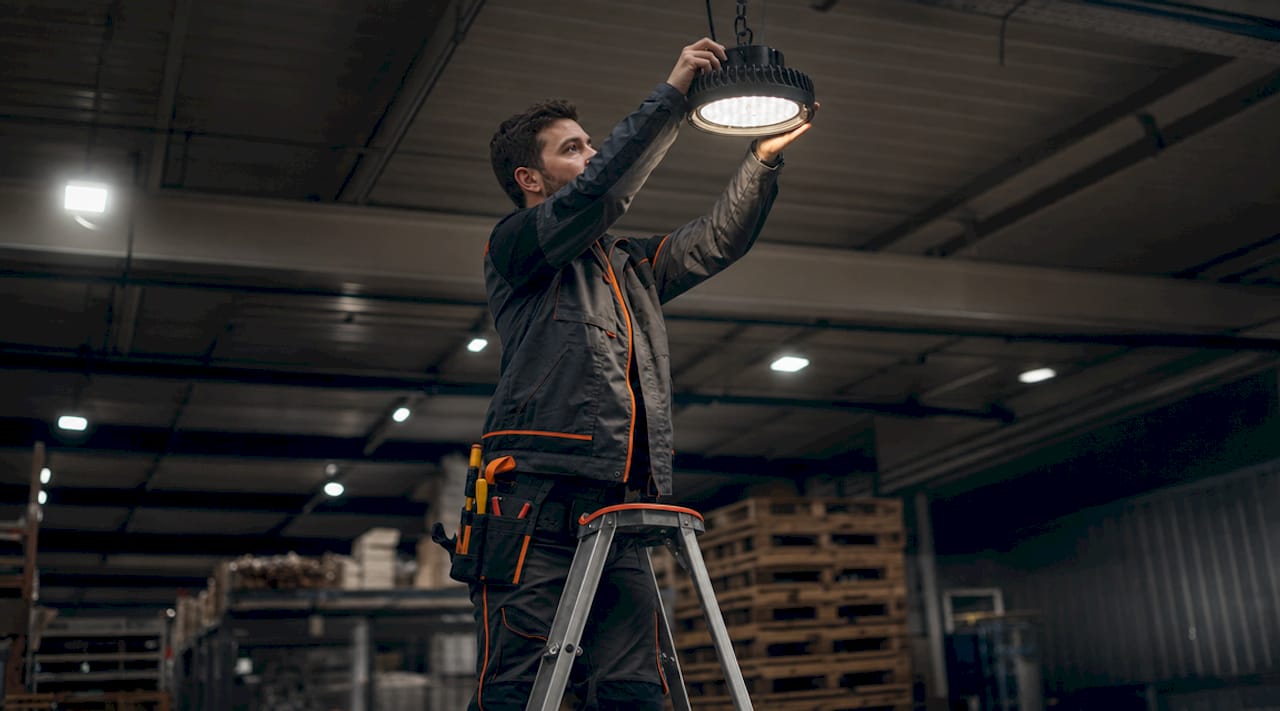
LED lighting for commercial properties is defined as the use of light-emitting diode technology to replace traditional fluorescent, incandescent, or halogen fixtures across offices, warehouses, retail spaces, and exterior areas. The U.S. Department of Energy confirms that LEDs reduce energy consumption by up to 75% and last up to 25 times longer than conventional bulbs. For facility managers and property owners in the Dallas-Fort Worth area, that combination of longevity and efficiency translates directly into lower operating costs, reduced maintenance calls, and a more attractive property. Common commercial LED solutions include high bay fixtures, panel lights, wall packs, and floodlights, each designed for a specific application and mounting environment.
1. LED lighting for commercial properties: which fixture type fits your space?
Choosing the right fixture is the single most consequential decision in any commercial LED upgrade. The wrong fixture in the wrong space wastes money, creates glare, and forces a costly rework. Here is a breakdown of the four primary fixture categories and where each performs best.
- High bay LED lights are designed for ceilings 15 feet and above, making them the standard choice for warehouses, distribution centers, and manufacturing floors. UFO-style high bays deliver a tight, focused beam that pushes light down to the work surface without spilling onto walls.
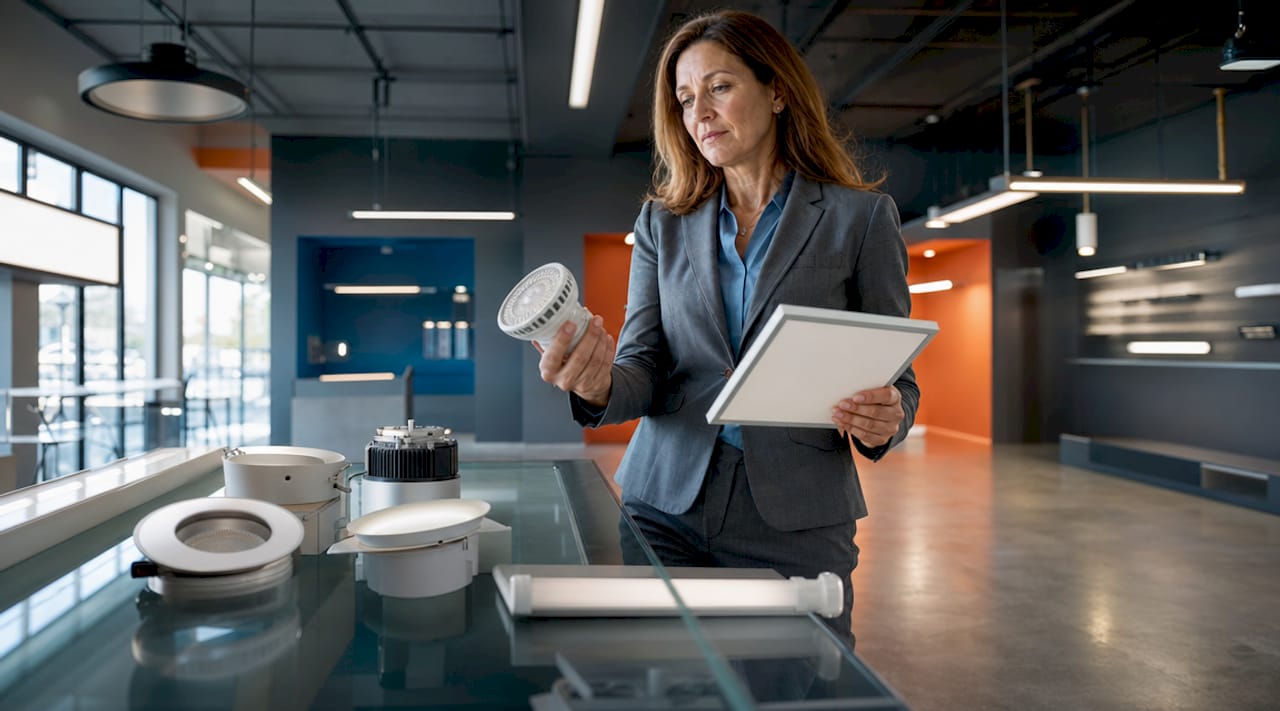
- LED panel lights replace drop-ceiling fluorescent troffers in offices, retail floors, and medical facilities. They produce uniform, glare-free illumination that supports sustained visual tasks and are among the best LED lights for offices available today.
- Wall packs mount on building exteriors to light entryways, loading docks, and perimeter walls. Full-cutoff wall packs direct light downward, reducing light pollution and meeting most municipal dark-sky ordinances.
- LED floodlights and area lights cover parking lots, sports courts, and large open exteriors. They replace metal halide and high-pressure sodium fixtures that take several minutes to warm up and consume two to three times more energy.
Each fixture type carries different IP (ingress protection) ratings. Outdoor fixtures should carry at least IP65 to handle rain and dust. Industrial environments with washdowns require IP67 or higher.
Pro Tip: When replacing metal halide high bays, do not match wattage for wattage. A 150-watt LED high bay typically replaces a 400-watt metal halide fixture and delivers equivalent or better foot-candles at the work surface.
2. How smart controls amplify energy efficient commercial lighting
Installing LEDs without smart controls leaves significant savings on the table. Combining LEDs with daylight harvesting and smart controls reduces total lighting energy use by 40 to 70 percent. That range is not theoretical. It reflects real-world deployments in office buildings, retail chains, and industrial facilities where controls were layered onto an already-efficient LED base.
The four control strategies that deliver the most measurable impact are:
- Occupancy sensors detect motion and shut off lights in unoccupied rooms, restrooms, stairwells, and storage areas. In a typical office building, 30 to 40 percent of spaces are unoccupied at any given time during business hours.
- Daylight harvesting uses photosensors to measure ambient natural light and dim artificial fixtures proportionally. Perimeter offices and skylighted warehouses see the greatest benefit from this approach.
- Scheduling and timers automate after-hours shutoffs for exterior lighting, parking structures, and common areas, eliminating the human error of lights left on overnight.
- Dynamic color tuning adjusts color temperature throughout the day, shifting from cooler 5000K light in the morning to warmer 3000K tones in the afternoon. Research confirms that dynamic lighting supports occupant health by aligning with natural circadian rhythms, which directly affects alertness and sleep quality.
Pro Tip: Pair occupancy sensors with a 5-minute time delay rather than an instant shutoff. Instant shutoffs in active spaces like warehouses create safety hazards when workers momentarily step out of the sensor’s detection zone.
3. Key factors in LED fixture selection and installation
Fixture selection goes beyond wattage and lumen output. Several technical factors determine whether your installation performs as expected or requires expensive corrections within the first year.
- Certification matters more than price. DLC Premium and UL-certified products prevent common failures including flicker, color shift, and premature driver burnout. DLC Premium certification also qualifies fixtures for utility rebate programs, which can offset 20 to 40 percent of upfront costs in Texas and surrounding states.
- Beam angle is a precision decision. Selecting the correct beam angle based on mounting height prevents light spill and uneven illumination. A 60-degree beam works well for mounting heights above 25 feet, concentrating light on the work surface. A 90-degree beam suits lower ceilings where wider spread is needed.
- Heat management determines lifespan. LEDs are sensitive to heat at the driver and junction level. Fixtures in enclosed spaces or near heat-generating equipment need adequate thermal dissipation, typically through aluminum heat sinks. A fixture running 10 degrees Celsius above its rated temperature can lose up to 50 percent of its rated lifespan.
The table below compares the two primary installation approaches for commercial LED upgrades.
| Approach | Cost | Downtime | Best for |
|---|---|---|---|
| Direct replacement (plug and play) | Lower upfront | Minimal | Functional existing fixtures |
| Full fixture retrofit | Higher upfront | Moderate | Outdated or damaged fixtures |
Direct-replacement LED bulbs reduce energy costs by approximately 68 percent with minimal downtime, making them the preferred starting point when existing fixtures are structurally sound. Full fixture retrofits cost more upfront but deliver better optical performance, longer warranties, and cleaner aesthetics.
4. Measurable benefits of switching to LED lighting
The financial case for commercial LED solutions is well-documented and consistent across property types. Here is what the data shows.
Energy consumption drops by up to 75% compared to incandescent or halogen sources. For a 50,000-square-foot warehouse running lights 16 hours per day, that reduction can translate to tens of thousands of dollars in annual utility savings. The lifespan advantage compounds those savings. LEDs rated at 50,000 to 100,000 hours require far fewer replacements than fluorescent tubes rated at 8,000 to 15,000 hours, which means lower labor costs and less operational disruption.
“Lighting is increasingly viewed through a health and productivity lens, with dynamic lighting supporting circadian rhythms and contributing to LEED and WELL building certifications that enhance property value.” — The Conversation
Lower heat output also reduces your building’s cooling load. Traditional metal halide and fluorescent fixtures convert a significant portion of their energy input into heat rather than light. Replacing them with LEDs means your HVAC system works less during summer months, a meaningful secondary saving in Texas’s climate. Commercial LED upgrades reduce maintenance costs through fewer replacements and less system downtime, which facility managers consistently rank as one of the most underappreciated benefits.
The table below summarizes the primary financial and operational benefits.
| Benefit | Typical Impact |
|---|---|
| Energy savings | Up to 75% reduction in lighting energy use |
| Lifespan | Up to 25x longer than incandescent or halogen |
| Maintenance cost | Significantly reduced due to fewer replacements |
| HVAC load | Reduced cooling demand from lower heat output |
| Rebate eligibility | DLC-certified fixtures qualify for utility rebates |
Energy-efficient lighting also contributes to LEED and WELL certifications, which increase building value and attract quality tenants who prioritize sustainability.
5. Common mistakes to avoid in commercial LED upgrades
Most LED upgrade projects that underperform share the same set of avoidable errors. Knowing them in advance saves you money and frustration.
- Buying non-certified fixtures to save upfront costs. Poor product choices lead to flicker, inconsistent color rendering, and shortened lifespans. The savings evaporate quickly when fixtures need replacement within two years.
- Treating the upgrade as a bulb swap rather than a lighting design project. Effective commercial LED solutions account for spacing, mounting height, reflectance values of walls and ceilings, and task-specific foot-candle requirements. A warehouse floor needs 30 to 50 foot-candles. A surgical suite needs 150 or more.
- Ignoring controls during the initial installation. Retrofitting controls after the fact costs more and often requires additional wiring runs. Planning for occupancy sensors and daylight harvesting from the start reduces both cost and disruption.
- Skipping a lighting audit before purchasing. A professional photometric analysis identifies dark spots, over-lit zones, and fixture spacing issues before you spend a dollar on hardware.
- Underestimating electrical infrastructure requirements. Older commercial buildings may have wiring or panel capacity that does not support a full LED retrofit without upgrades. A licensed electrician should assess the existing system before LED fixture installation begins.
Regular reassessment every three to five years keeps your system performing at peak efficiency. LED technology continues to improve, and fixtures installed in 2020 may already be outperformed by current DLC Premium options at the same or lower price point.
Key takeaways
LED lighting for commercial properties delivers maximum ROI when certified fixtures, application-specific selection, and smart controls are combined from the start of the project.
| Point | Details |
|---|---|
| Fixture selection drives performance | Match fixture type to ceiling height, application, and IP rating before purchasing. |
| Smart controls multiply savings | Occupancy sensors and daylight harvesting reduce lighting energy use by 40 to 70 percent beyond LEDs alone. |
| Certification protects your investment | DLC Premium and UL-listed products prevent flicker, color failure, and qualify for utility rebates. |
| Full design approach beats bulb swaps | Spacing, controls, and foot-candle targets matter as much as the fixture itself. |
| Secondary savings are real | Reduced HVAC load and lower maintenance labor add measurable value beyond the utility bill. |
Why integrated LED design beats piecemeal upgrades every time
I have seen facility managers make the same mistake repeatedly: they approve a budget for LED bulbs, swap out the old fixtures one-for-one, and then wonder why their energy bills only dropped 20 percent instead of the 60 percent they were promised. The problem is almost never the LEDs themselves. It is the absence of a system-level approach.
The properties that see the strongest results treat lighting as an integrated system. They combine certified fixtures with occupancy sensors, schedule exterior lights on timers, and run a photometric study before ordering a single fixture. That process takes more time upfront, but it eliminates the rework costs and the disappointment of a project that underdelivers.
I am also watching the health-centric lighting trend accelerate faster than most facility managers expect. Dynamic color tuning was a premium feature two years ago. Today it is available in mid-range commercial panels at no significant cost premium. Properties pursuing WELL Building Standard certification are already specifying tunable white fixtures as a baseline requirement, not an upgrade. If you manage a multi-tenant office building or a healthcare facility, this is worth factoring into your next lighting specification.
My practical advice: start with a lighting audit, specify DLC Premium fixtures, and build controls into the initial scope. Do not treat them as optional add-ons. The payback period on a properly designed commercial LED system in the DFW area typically runs two to four years, after which the savings are pure return on your investment.
— Adrian
Ready to upgrade your commercial property’s lighting?
Dfwledpro specializes in professional LED lighting installation for commercial properties across the Dallas-Fort Worth metroplex, including Arlington, Fort Worth, Grand Prairie, Mansfield, and 30-plus surrounding cities. As the authorized JellyFish Lighting dealer for the DFW area, we bring certified products and proven installation expertise to every project, from warehouse high bays to exterior wall packs and parking lot area lights.
Whether you are managing a single retail location or a multi-building industrial campus, our team handles fixture selection, photometric planning, and full LED fixture installation so you get the energy savings and performance your property deserves. Visit our commercial LED solutions page to request a custom quote or schedule a lighting consultation with our team.
FAQ
How much can LED lighting reduce my commercial energy bill?
LED lighting reduces energy consumption by up to 75% compared to incandescent and halogen sources. When combined with smart controls and daylight harvesting, total lighting energy use drops by 40 to 70 percent beyond LEDs alone.
What LED fixtures work best for warehouse spaces?
High bay LED fixtures are the standard choice for warehouses with ceilings 15 feet and above. Beam angle selection based on mounting height is critical: use a 60-degree beam for heights above 25 feet and a 90-degree beam for lower ceilings to achieve uniform illumination.
Should I replace bulbs or upgrade the entire fixture?
Direct-replacement LED bulbs reduce energy costs by about 68% with minimal downtime and are the right choice when existing fixtures are structurally sound. Full fixture retrofits cost more upfront but deliver better optical performance, longer warranties, and cleaner aesthetics for damaged or outdated housings.
Do I need certified LED products for a commercial installation?
Yes. DLC Premium and UL-certified LEDs prevent flicker, color inconsistency, and premature failure. Certified products also qualify for utility rebate programs that can offset a significant portion of your upfront installation costs.
How long do commercial LED fixtures typically last?
Commercial LED fixtures are rated for 50,000 to 100,000 hours of operation, which is up to 25 times longer than incandescent bulbs and four to six times longer than standard fluorescent tubes. That lifespan dramatically reduces replacement frequency and maintenance labor costs over the life of the system.